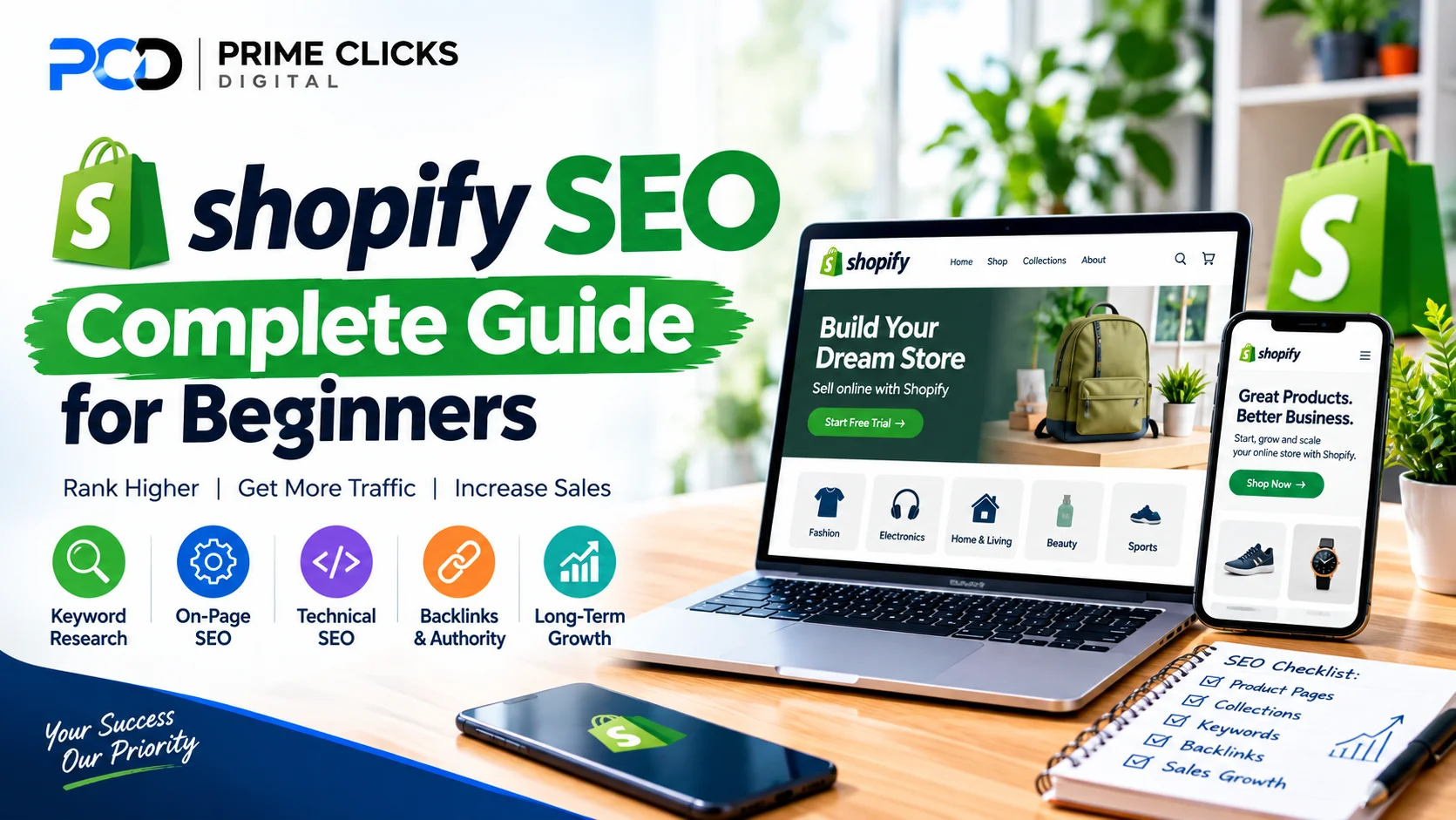
Shopify SEO: Complete Guide for Beginners
If you have a Shopify store, getting your products in front of potential customers is one of the biggest challenges of growing your online business.
You can have great products, professional product photography, competitive prices, and an attractive Shopify website, but customers still need to find your store before they can buy from you.
This is where Shopify SEO becomes important.
Shopify SEO is the process of optimizing your Shopify store so that search engines like Google can better understand your website, products, collections, and content. A well-optimized Shopify store can improve its organic search visibility, attract relevant visitors, and create more opportunities for sales without relying entirely on paid advertising.
This complete Shopify SEO guide is designed for beginners. You will learn what Shopify SEO is, why it matters, how to optimize product pages and collection pages, how to perform keyword research, how to improve technical SEO, how to create SEO-friendly content, and how to build a long-term SEO strategy for your Shopify store.
What Is Shopify SEO?
Shopify SEO is the process of optimizing a Shopify ecommerce website to improve its visibility in organic search results.
It includes several areas of optimization, including:
- Keyword research
- Product page SEO
- Collection page SEO
- Homepage SEO
- Technical SEO
- Internal linking
- Image optimization
- Content marketing
- Structured data
- Backlinks
- User experience
- Mobile optimization
- Page speed
- Conversion optimization
For example, if you sell running shoes, potential customers might search Google for:
- running shoes
- best running shoes
- men’s running shoes
- women’s running shoes
- lightweight running shoes
- running shoes for beginners
- waterproof running shoes
Your Shopify store needs to clearly communicate what your products are and why they are relevant to these searches.
Why Is Shopify SEO Important?
SEO can help Shopify stores attract customers who are already searching for products or information related to what they sell.
1. Increase Organic Traffic
Organic search can provide a consistent source of website visitors when your pages rank for relevant searches.
Unlike paid advertising, organic clicks do not require paying for every individual visit.
However, SEO requires ongoing work and does not guarantee rankings.
2. Reach Customers With Purchase Intent
Someone searching for:
“buy leather wallet online”
may have stronger purchase intent than someone searching for:
“what is a leather wallet?”
Understanding search intent helps you create the right page for each keyword.
3. Improve Product Discoverability
SEO helps search engines understand your products and categories.
When your product titles, descriptions, URLs, images, internal links, and structured data are properly optimized, search engines have more useful information about your store.
4. Reduce Dependence on Paid Traffic
Paid advertising can be an important part of ecommerce marketing, but relying entirely on advertising can become expensive.
Organic SEO can provide another source of qualified traffic over time.
5. Build Long-Term Visibility
SEO is a long-term strategy.
A useful product guide, comparison article, or category page can continue attracting organic traffic after it has been published and optimized.
How Does Shopify SEO Work?
Search engines use automated systems to discover, crawl, understand, and index webpages.
When someone searches for something, search engines determine which indexed pages are relevant to the query.
For a Shopify store, search engines may analyze information such as:
- Page content
- Product information
- Titles
- Headings
- Links
- Images
- Structured data
- Website architecture
- Page experience
- External links
- Search intent
Your goal is to make your website easy for both users and search engines to understand.
Shopify SEO Keyword Research
Keyword research should be one of the first steps in your SEO strategy.
A keyword is a word or phrase people use when searching for something online.
For example, an ecommerce store selling skincare products might target keywords such as:
- organic skincare
- natural face moisturizer
- vitamin C serum
- moisturizer for dry skin
- best face serum
- anti-aging skincare products
However, choosing keywords simply because they have high search volume is not enough.
You should consider:
- Search intent
- Relevance
- Competition
- Commercial value
- Product availability
- Customer needs
Understand Search Intent
Search intent refers to the reason behind a search.
There are several common types.
Informational Intent
The user wants information.
Examples:
- How does vitamin C serum work?
- How to choose running shoes
- What is organic skincare?
Blog posts and guides can target these searches.
Commercial Investigation
The user is researching products before purchasing.
Examples:
- Best running shoes for beginners
- Shopify SEO tools
- Best moisturizer for dry skin
Comparison guides and product-focused content can target these searches.
Transactional Intent
The user is ready to take action.
Examples:
- Buy running shoes
- Buy organic face serum
- Women’s leather handbags online
Product and collection pages can target these searches.
Navigational Intent
The user is looking for a specific website or brand.
Examples:
- Nike running shoes
- Shopify login
- Apple store
Understanding intent helps you assign the right keyword to the right page.
Optimize Your Shopify Homepage
Your homepage is one of the most important pages on your Shopify store.
It should clearly communicate:
- What your business sells
- Who your products are for
- Your main product categories
- Your brand
- Your value proposition
Homepage SEO Title
Your SEO title should describe your business naturally.
For example:
Premium Running Shoes for Men & Women | Brand Name
Avoid stuffing the title with unrelated keywords.
Meta Description
Your meta description should summarize what customers can find on your website.
For example:
Shop premium running shoes for men and women. Explore lightweight, comfortable footwear designed for training, running, and everyday performance.
The goal is to encourage relevant users to click.
Shopify Product Page SEO
Product pages are extremely important for ecommerce SEO.
A product page should provide enough information for both customers and search engines.
Product Title
Your product title should clearly identify the product.
Weak example:
Super Shoes
Better:
Men’s Lightweight Running Shoes – Breathable Training Sneakers
The title should remain natural and readable.
Product Description
Do not simply copy a manufacturer’s description.
Create original product content that explains:
- What the product is
- Main benefits
- Features
- Materials
- Size information
- Use cases
- Care instructions
- Shipping information
- Warranty information
Use descriptive language that helps customers make purchasing decisions.
Optimize Product Descriptions for Search Intent
Suppose you sell a waterproof hiking backpack.
Instead of writing only:
“High-quality hiking backpack with multiple pockets.”
You could provide more useful information:
“This waterproof hiking backpack is designed for day hikes, travel, and outdoor adventures. The lightweight construction includes multiple compartments for organizing clothing, water bottles, hiking equipment, and personal items.”
The second example provides significantly more context.
However, avoid adding unnecessary text simply to make the page longer.
The content should help customers.
Optimize Shopify Product URLs
Shopify automatically creates product URLs using a structure similar to:
/products/product-name
Keep the product handle concise and descriptive.
For example:
/products/mens-waterproof-hiking-backpack
is clearer than a URL containing unnecessary numbers or unrelated words.
Avoid changing URLs unnecessarily because URL changes can create redirects and potentially affect existing search visibility.
Shopify Collection Page SEO
Collection pages are often overlooked.
For ecommerce websites, collection pages can target valuable category-level keywords.
For example:
- /collections/mens-running-shoes/
- /collections/womens-running-shoes/
- /collections/hiking-backpacks/
- /collections/organic-skincare/
A collection page should explain:
- What products are included
- Who they are for
- Important features
- How customers can choose
- Relevant product categories
Add useful introductory content where appropriate.
Do not add large blocks of keyword-stuffed text just for SEO.
Optimize Shopify Images
Images are extremely important for ecommerce websites.
Customers need high-quality product images to understand what they are buying.
However, large images can also affect page performance.
Image SEO Best Practices
Before uploading images:
- Compress images
- Use appropriate dimensions
- Use descriptive file names
- Add useful alt text
- Avoid unnecessarily large files
For example, instead of:
IMG_12345.jpg
use:
black-leather-wallet.jpg
Image Alt Text
Alt text should describe the image accurately.
Example:
Black leather men’s wallet with multiple card slots
Do not fill alt text with keywords that do not describe the image.
Shopify Technical SEO
Technical SEO helps search engines crawl and understand your website.
Important technical areas include:
- Website architecture
- Crawlability
- Indexability
- Canonical URLs
- Redirects
- XML sitemap
- Robots directives
- Mobile usability
- Page speed
- HTTPS
- Structured data
- Broken links
Shopify handles many technical components automatically, but store owners should still monitor the website for problems.
Shopify XML Sitemap
Shopify automatically generates an XML sitemap for your store.
The sitemap helps search engines discover important pages.
After connecting your website to Google Search Console, you can submit your sitemap.
The sitemap location is typically:
/sitemap.xml
You should monitor Search Console for indexing problems and coverage-related issues.
Shopify Robots.txt
Shopify provides a robots.txt file that gives search engine crawlers instructions about which areas of the website can be crawled.
Store owners should avoid making unnecessary changes to crawling rules.
Incorrect robots directives can prevent search engines from accessing pages that you actually want indexed.
Canonical URLs
Ecommerce websites can sometimes create multiple URLs that lead to similar or identical content.
Canonical signals help search engines understand which URL should be treated as the preferred version.
Shopify handles many canonical elements automatically, but you should still monitor your store for duplicate or near-duplicate content.
Shopify Site Speed Optimization
Page speed matters for both user experience and search performance.
Customers do not want to wait for product pages to load.
Common causes of slow Shopify stores include:
- Large images
- Too many apps
- Unnecessary scripts
- Heavy themes
- Third-party tracking
- Poorly optimized code
- Excessive animations
How to Improve Shopify Speed
You can:
- Compress images
- Use modern image formats where appropriate
- Remove unused apps
- Reduce unnecessary third-party scripts
- Choose a lightweight theme
- Minimize unnecessary animations
- Optimize fonts
- Monitor Core Web Vitals
Do not install multiple apps that perform the same function.
Every additional app can potentially add scripts or functionality that affects performance.
Mobile SEO for Shopify
Most ecommerce businesses receive a significant amount of traffic from mobile devices.
Your Shopify store should therefore work properly on:
- Smartphones
- Tablets
- Desktop computers
Check:
- Font size
- Navigation
- Product images
- Buttons
- Checkout experience
- Menus
- Product variations
- Search functionality
A customer should be able to browse and purchase products comfortably from a mobile device.
Shopify Internal Linking
Internal links connect pages within your website.
For example, a blog article about running can link to your:
Men’s Running Shoes
collection.
A product page can link to:
Running Accessories
or a related product.
Internal linking can help:
- Users discover relevant products
- Search engines discover pages
- Distribute internal authority
- Establish topical relationships
Use descriptive anchor text.
Instead of:
Click here
use:
Shop men’s running shoes
when appropriate.
Shopify Blog SEO
Content marketing can help Shopify stores attract customers earlier in the buying journey.
For example, a skincare store could publish:
- How to Build a Simple Skincare Routine
- Best Ingredients for Dry Skin
- How to Choose a Face Moisturizer
- Vitamin C Serum: Benefits and Uses
- Morning vs Evening Skincare Routine
A sports store could publish:
- How to Choose Running Shoes
- Best Running Shoes for Beginners
- How Often Should You Replace Running Shoes?
- Trail Running vs Road Running
- How to Prevent Common Running Injuries
The content should answer real customer questions.
Create Topic Clusters
Instead of publishing random blog posts, organize content around related topics.
For example:
Main Topic
Running Shoes Guide
Supporting articles:
- Best Running Shoes for Beginners
- How to Choose Running Shoes
- Running Shoes for Flat Feet
- Road vs Trail Running Shoes
- How Often Should Running Shoes Be Replaced?
Then connect these articles using internal links.
This creates a more organized topical structure.
Shopify Structured Data
Structured data helps search engines understand specific information about webpages.
For ecommerce websites, relevant structured data can include information about:
- Products
- Offers
- Prices
- Availability
- Reviews
- Organization
- Breadcrumbs
Product structured data can help search engines understand information such as:
- Product name
- Brand
- Price
- Currency
- Availability
- Product identifiers
Structured data must accurately represent information on the page.
Adding schema does not guarantee that Google will display rich results.
Shopify Breadcrumbs
Breadcrumbs show users where they are within the website structure.
For example:
Home → Men’s Shoes → Running Shoes → Lightweight Running Shoe
Breadcrumbs can make navigation easier and help search engines understand page relationships.
They are especially useful for ecommerce stores with many categories and products.
Shopify SEO and Duplicate Content
Ecommerce stores often have similar or duplicated content.
Common causes include:
- Similar products
- Product variants
- Collection filtering
- Manufacturer descriptions
- Multiple URLs
- Tag pages
Avoid copying descriptions directly from manufacturers when possible.
Create unique, useful product content that provides additional value.
Build High-Quality Backlinks
Backlinks are links from other websites to your website.
Relevant links can help establish authority and discoverability.
Potential opportunities include:
- Industry publications
- Product reviews
- Business directories
- Relevant blogs
- Supplier websites
- Partnerships
- Digital PR
- Expert interviews
- Resource pages
Do not focus on obtaining hundreds of low-quality links.
Relevance and quality are more important than simply increasing the number of backlinks.
Shopify SEO for International Stores
If you sell products internationally, your SEO strategy may need to account for:
- Different countries
- Languages
- Currencies
- Shipping regions
- Local search behavior
Use appropriate international SEO features and configurations.
Avoid automatically creating large numbers of thin pages for every country or language.
Each localized experience should provide genuine value to customers in that market.
Shopify SEO and AI Search
Search is increasingly expanding beyond traditional blue-link results.
Users may discover products through AI-powered search and answer engines.
This makes clear, trustworthy, structured information increasingly important.
Your Shopify store should clearly communicate:
- What products you sell
- Product specifications
- Prices where appropriate
- Availability
- Shipping information
- Return policies
- Product benefits
- Frequently asked questions
- Brand information
AEO for Shopify
Answer Engine Optimization focuses on creating content that can directly answer customer questions.
Examples:
What size running shoes should I buy?
Are these shoes waterproof?
How should I clean this leather bag?
What is the difference between the two product models?
Provide concise answers while offering deeper information where necessary.
GEO for Shopify
Generative Engine Optimization focuses on making your content clear and useful for AI-powered search experiences.
Helpful practices include:
- Original content
- Clear product information
- Authoritative guides
- FAQs
- Structured data
- Consistent brand information
- Relevant external mentions
- Expert information
There is no guaranteed method for making an AI system mention a particular store.
The objective should be to make your website useful, understandable, and trustworthy.
Shopify SEO Analytics
SEO should be measured using meaningful data.
Google Search Console
Search Console can show:
- Search queries
- Impressions
- Clicks
- Average position
- Indexed pages
- Search performance
Use this information to identify pages and queries that need improvement.
Google Analytics
Analytics can help you understand:
- Organic traffic
- User behavior
- Landing pages
- Engagement
- Ecommerce activity
- Conversions
For Shopify stores, track commercially meaningful actions such as:
- Product views
- Add-to-cart events
- Checkout activity
- Purchases
- Revenue
Shopify SEO Metrics to Monitor
Important metrics can include:
Organic Clicks
How many users arrive through organic search.
Impressions
How often your pages appear in search results.
Click-Through Rate
The percentage of impressions that result in clicks.
Keyword Visibility
How your pages perform for relevant search queries.
Organic Revenue
How much revenue can be attributed to organic search according to your analytics setup.
Conversion Rate
The percentage of visitors who complete a desired action.
Product Page Performance
Identify which products receive organic visibility and which need improvement.
Common Shopify SEO Mistakes
1. Keyword Stuffing
Repeating keywords excessively does not create better content.
Write naturally.
2. Copying Manufacturer Descriptions
Duplicate product descriptions can make it harder to differentiate your pages.
Create original descriptions whenever possible.
3. Ignoring Collection Pages
Collection pages can target important category-level searches.
Do not focus exclusively on individual products.
4. Uploading Huge Images
Large images can slow down your website.
Compress images before or during upload.
5. Installing Too Many Apps
Apps can add functionality, but unnecessary apps may increase complexity and page weight.
Review installed apps regularly.
6. Ignoring Mobile Users
A store that works poorly on smartphones can lose customers.
Always test the mobile shopping experience.
7. Creating Thin Blog Posts
Publishing hundreds of low-value articles is not a substitute for useful content.
Focus on customer questions and genuine expertise.
8. Changing URLs Without Planning
Unplanned URL changes can cause broken links and loss of existing signals.
Use appropriate redirects when URLs must change.
Shopify SEO Checklist
Use this checklist when optimizing a Shopify store.
Homepage
- Optimize SEO title
- Write a useful meta description
- Explain the brand clearly
- Highlight important categories
- Add internal links
- Optimize images
Product Pages
- Write unique product titles
- Create original descriptions
- Optimize URLs
- Add relevant keywords naturally
- Optimize images
- Add descriptive alt text
- Include product specifications
- Add relevant structured data
- Add internal links
Collection Pages
- Optimize collection titles
- Write useful descriptions
- Target relevant category keywords
- Add internal links
- Use descriptive URLs
Technical SEO
- Check indexing
- Review sitemap
- Monitor robots directives
- Check canonical URLs
- Fix broken links
- Improve page speed
- Optimize mobile experience
- Monitor Core Web Vitals
- Use HTTPS
Content Marketing
- Research customer questions
- Create useful blog posts
- Build topic clusters
- Link related content
- Update outdated content
- Avoid thin content
Authority
- Build relevant backlinks
- Earn industry mentions
- Develop partnerships
- Promote useful content
- Build brand awareness
Analytics
- Connect Google Search Console
- Connect Google Analytics
- Track organic traffic
- Monitor impressions
- Monitor clicks
- Track ecommerce conversions
- Measure organic revenue
A Simple Shopify SEO Strategy for Beginners
If you are new to SEO, do not try to optimize everything at once.
Follow this process.
Step 1: Research Your Customers
Understand what your customers sell, search for, compare, and ask before purchasing.
Step 2: Perform Keyword Research
Identify relevant keywords for:
- Homepage
- Collections
- Products
- Blog posts
Step 3: Optimize Important Pages
Start with your:
- Homepage
- Main collections
- Best-selling products
Step 4: Improve Technical SEO
Check:
- Mobile usability
- Speed
- Indexing
- Broken links
- Sitemap
- Canonicals
Step 5: Create Helpful Content
Publish guides that answer customer questions.
Step 6: Improve Internal Linking
Connect related products, collections, and blog posts.
Step 7: Build Authority
Earn relevant backlinks and mentions.
Step 8: Measure Results
Use Search Console and Analytics to identify what is working and where improvements are needed.
Step 9: Continue Updating
SEO is not a one-time task.
Continue improving your products, content, technical performance, and user experience.
Frequently Asked Questions About Shopify SEO
Is Shopify good for SEO?
Shopify provides many built-in features that support SEO, including editable page titles and descriptions, sitemap generation, mobile-friendly themes, canonical elements, and other technical functionality. However, store owners still need to optimize content, products, site structure, performance, and authority.
How long does Shopify SEO take?
There is no fixed timeline. Results can vary depending on competition, website authority, technical condition, content quality, backlinks, search demand, and the number of pages being optimized.
Can a new Shopify store rank on Google?
Yes, a new Shopify store can appear in Google search results, but ranking competitively can take time. A strong strategy should focus on relevant keywords, useful content, technical SEO, product optimization, and authority building.
Does Shopify SEO increase sales?
SEO can increase qualified organic traffic and product visibility, which can create more opportunities for sales. Actual sales depend on many other factors, including product quality, pricing, customer experience, website usability, competition, and conversion optimization.
Do Shopify product descriptions matter for SEO?
Yes. Useful, original product descriptions can help customers and search engines understand your products. They should provide meaningful information rather than simply repeating keywords.
Should every Shopify product have a unique description?
Whenever practical, yes. Unique descriptions can help differentiate products and provide customers with useful information.
Do Shopify apps help SEO?
Some apps can provide useful SEO functionality, but an app is not automatically necessary for every SEO task. Too many apps can add unnecessary complexity or scripts to your store.
How do I improve Shopify page speed?
Start by optimizing images, reviewing installed apps, reducing unnecessary scripts, using an efficient theme, and monitoring Core Web Vitals.
What is the difference between Shopify SEO and Google Ads?
Shopify SEO focuses primarily on organic search visibility. Google Ads uses paid advertising placements. They can be used together as part of a broader ecommerce marketing strategy.
Does Shopify SEO work for dropshipping stores?
Yes, but dropshipping stores face strong competition and often use similar supplier product descriptions. Original product information, useful content, strong branding, technical SEO, and a good customer experience can help differentiate a store.
Final Thoughts
Shopify SEO is an ongoing process that combines ecommerce strategy, technical optimization, content, user experience, and search visibility.
The goal is not simply to place keywords on product pages.
A successful Shopify SEO strategy should help search engines understand your store while making it easier for customers to discover, evaluate, and purchase your products.
Start with the fundamentals:
Keyword Research → Homepage SEO → Collection SEO → Product SEO → Technical SEO → Image Optimization → Internal Linking → Content Marketing → Structured Data → Backlinks → Analytics
Then expand your strategy with AEO and GEO to make your product information easier to understand across modern search and AI-powered discovery experiences.
Most importantly, create your Shopify store for people first.
Provide accurate product information, helpful descriptions, high-quality images, transparent policies, easy navigation, fast pages, and a smooth checkout experience.
When SEO and customer experience work together, your Shopify store has a stronger foundation for sustainable organic growth.
Need Shopify SEO Help?
If your Shopify store is not getting enough organic traffic, rankings, or sales from Google, a professional Shopify SEO audit can help identify technical, on-page, content, and visibility opportunities.
Prime Clicks Digital provides Shopify SEO services focused on improving ecommerce search visibility, product and collection optimization, technical SEO, site performance, structured data, content strategy, and AI search visibility.
You can request a Free SEO Audit to identify potential SEO issues and opportunities for your Shopify store.
Website: https://www.primeclicksdigital.com/
Email: info@primeclicksdigital.com
WhatsApp: +8801779636906
Shopify SEO Services: Shopify SEO Audit | Keyword Research | Product SEO | Collection SEO | Technical SEO | Shopify Speed Optimization | Image SEO | Schema Markup | Content SEO | Internal Linking | Backlink Strategy | GEO & AEO | AI Search Visibility