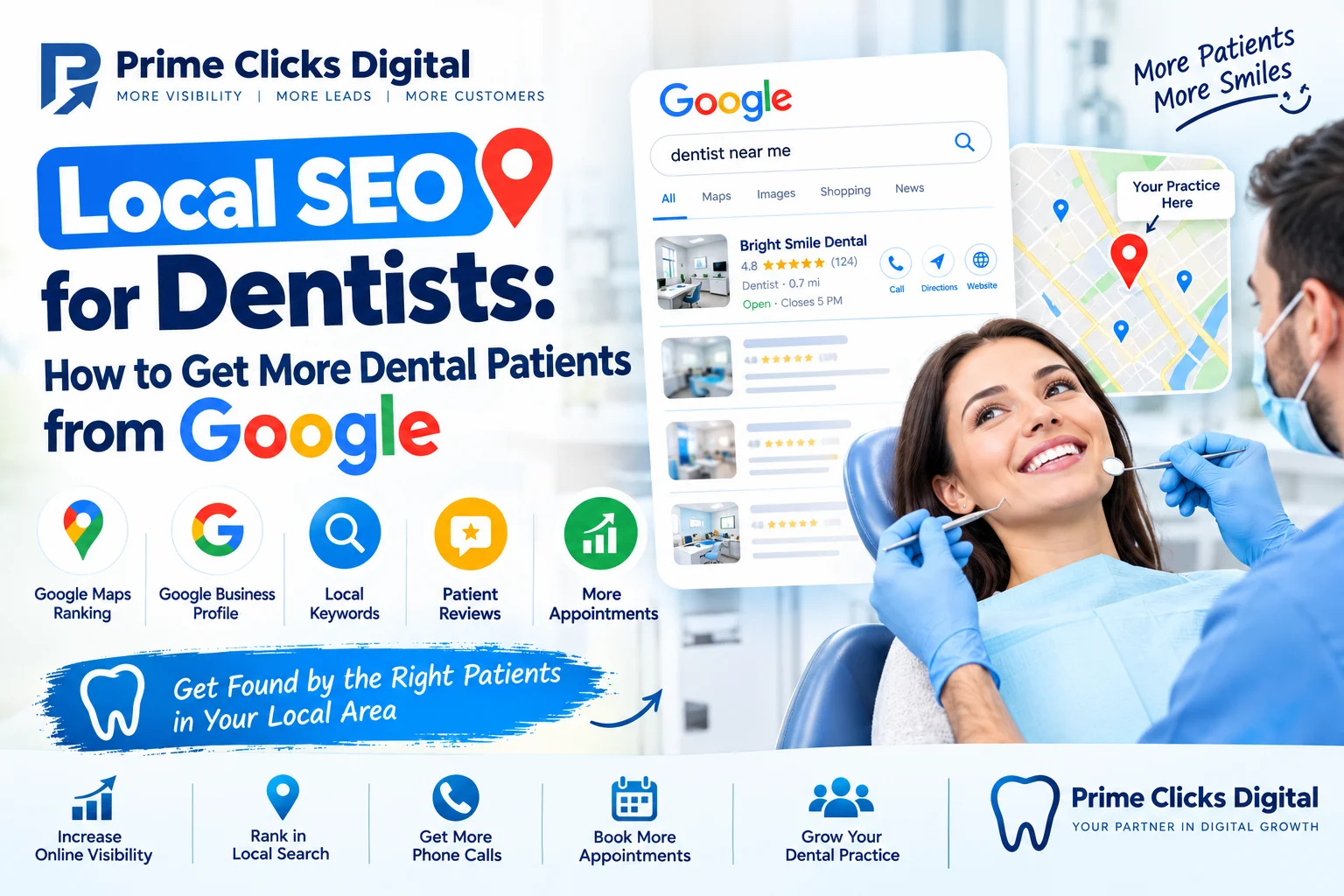
Local SEO for Dentists: How to Get More Dental Patients from Google
For most dental practices, getting new patients consistently is one of the biggest challenges in growing a successful business. People no longer rely only on referrals, newspaper advertisements, or traditional marketing when looking for a dentist. Instead, they turn to Google to find nearby dental practices, compare reviews, research treatments, and decide which dentist to contact.
Searches such as “dentist near me,” “best dentist in [city],” “emergency dentist near me,” “teeth whitening near me,” and “family dentist in [city]” can connect dental practices with people who are actively looking for dental services.
This is where Local SEO for dentists becomes extremely valuable.
Local SEO is the process of optimizing your dental practice’s online presence so that your business can become more visible when potential patients search for dental services in your local area.
A strong dental Local SEO strategy can help improve visibility in:
- Google Search
- Google Maps
- Local Pack results
- Organic search results
- Voice and conversational search
- AI-powered search experiences
However, ranking locally is not simply about adding the word “dentist” to your website. A successful strategy requires a combination of Google Business Profile optimization, local keyword research, website SEO, reviews, location signals, helpful content, technical SEO, authority building, and conversion optimization.
In this guide, you’ll learn how dentists can use Local SEO to attract more qualified patients and grow their practice.
What Is Local SEO for Dentists?
Local SEO for dentists is the process of optimizing a dental practice’s online presence to appear prominently when people search for dental services in a specific geographic area.
For example, someone living in Dallas may search:
- Dentist near me
- Dentist in Dallas
- Family dentist Dallas
- Emergency dentist Dallas
- Cosmetic dentist near me
- Teeth whitening Dallas
- Dental implants Dallas
- Pediatric dentist near me
If your dental practice appears prominently when potential patients perform these searches, you have an opportunity to generate website visits, phone calls, appointment requests, and new patients.
Local SEO is especially important for dentists because dental services are highly location-dependent.
A person searching for a dentist generally wants a practice that is convenient to reach.
Why Local SEO Is Important for Dental Practices
Dental patients typically compare several practices before making an appointment.
They may look at:
- Google ratings
- Number of reviews
- Location
- Services
- Office photos
- Website quality
- Business hours
- Dentist credentials
- Insurance information
- Appointment availability
- Patient experience
A strong online presence can help your practice stand out from competitors.
Local SEO can help dentists:
- Increase Google visibility
- Appear in Google Maps
- Generate more website traffic
- Increase phone calls
- Generate appointment requests
- Build trust
- Reach nearby patients
- Improve brand visibility
- Compete with larger practices
The goal isn’t simply to rank for keywords.
The real goal is to turn local search visibility into qualified patient inquiries and appointments.
1. Optimize Your Google Business Profile
One of the most important components of dental Local SEO is your Google Business Profile (GBP).
Your profile can appear when people search for your practice or dental services in your local area.
Make sure your profile contains accurate and complete information.
Important elements include:
- Practice name
- Correct address
- Phone number
- Website
- Primary category
- Secondary categories where appropriate
- Business hours
- Holiday hours
- Services
- Photos
- Business description
- Appointment URL where applicable
Your business information should be consistent across your website and other important online profiles.
2. Choose the Right Primary Category
Your Google Business Profile category helps Google understand what your business does.
A dental practice should choose the most accurate primary category available for its business.
Additional categories may be appropriate depending on the services and practice structure.
Avoid selecting unrelated categories simply because you think they might generate more visibility.
Your categories should accurately represent the business.
3. Add Your Dental Services
Make sure your important services are clearly represented on your Google Business Profile and website.
Depending on your practice, services may include:
- General Dentistry
- Cosmetic Dentistry
- Emergency Dentistry
- Dental Cleaning
- Teeth Whitening
- Dental Implants
- Dental Crowns
- Dental Bridges
- Root Canal Treatment
- Dentures
- Pediatric Dentistry
- Orthodontic Services
Only list services that your practice actually provides.
Service information should also be clearly explained on your website.
4. Use Dental Local Keywords
Keyword research is a major part of Local SEO.
Instead of targeting only broad keywords such as:
dentist
identify more specific searches that reflect location and patient intent.
Examples include:
- Dentist near me
- Dentist in Miami
- Family dentist in Miami
- Emergency dentist Miami
- Cosmetic dentist Miami
- Dental implants Miami
- Teeth whitening Miami
- Pediatric dentist Miami
- Affordable dentist Miami
Combine Service + Location
A useful keyword structure is:
[Dental Service] + [Location]
For example:
- Dentist + New York
- Dental implants + Brooklyn
- Cosmetic dentist + Los Angeles
- Emergency dentist + Chicago
You can also target neighborhood-level searches when they are relevant to your actual service area.
5. Create Dedicated Dental Service Pages
One of the biggest SEO mistakes dental practices make is putting every service on a single page.
Instead, create dedicated pages for important services.
For example:
- General Dentistry
- Emergency Dentistry
- Dental Implants
- Teeth Whitening
- Cosmetic Dentistry
- Pediatric Dentistry
- Root Canal Treatment
Each page should explain the service clearly and answer the questions patients commonly have.
A service page can include:
- What the service is
- Who it may be suitable for
- General benefits
- What patients can expect
- Frequently asked questions
- Relevant images
- Appointment CTA
- Practice information
For healthcare-related content, accuracy and appropriate professional review are especially important.
6. Create Location Pages
If your dental practice genuinely serves multiple locations, location-specific pages can help search engines and patients understand where you operate.
For example:
- Dentist in Brooklyn
- Dentist in Queens
- Dentist in Manhattan
Each location page should contain genuinely useful, location-specific information.
Avoid creating dozens of nearly identical pages by simply changing the city name.
A useful location page could include:
- Address
- Service area
- Nearby landmarks
- Parking information
- Transportation information
- Local services
- Relevant dental services
- Unique practice information
The goal should be to help the patient—not simply create pages for search engines.
7. Optimize Your Dental Website for Local SEO
Your website should make it immediately clear:
Who you are, what services you provide, and where you are located.
Include your important business information in appropriate areas such as:
- Header
- Footer
- Contact page
- About page
- Location pages
Your website should include:
- Practice name
- Address
- Phone number
- Hours
- Service information
- Location
- Appointment options
Make sure this information is accurate and consistent.
8. Optimize Your Homepage
Your homepage is often one of the most important pages on your website.
A dental homepage should clearly communicate the practice’s primary services and location.
For example:
Trusted Family Dentist in [City]
Then explain:
- Who the practice serves
- Main dental services
- What makes the practice different
- Where the practice is located
- How patients can schedule an appointment
Add a clear call-to-action such as:
Book an Appointment
or
Call Our Dental Office
Avoid making visitors search through the website to find your phone number or appointment button.
9. Build a Strong Review Strategy
Reviews are extremely important for local businesses, including dental practices.
Potential patients often look at reviews before deciding whether to contact a dentist.
Encourage genuine patients to share honest feedback about their experience.
You can request reviews after appropriate interactions, such as after completing a visit or when a patient expresses satisfaction.
Never create fake reviews or offer misleading incentives for positive reviews.
Respond to Reviews
Respond professionally to reviews when appropriate.
For positive reviews:
- Thank the patient
- Show appreciation
- Keep the response professional
For negative reviews:
- Remain professional
- Avoid discussing private patient information
- Do not reveal confidential details
- Encourage the person to contact the practice directly when appropriate
Healthcare businesses should be particularly careful about privacy when responding publicly.
10. Add High-Quality Dental Photos
Visual content can make your Google Business Profile and website more trustworthy.
Consider adding appropriate photos of:
- Exterior
- Reception area
- Treatment rooms
- Staff
- Dentist
- Equipment
- Office environment
Use high-quality, authentic images whenever possible.
Avoid using misleading stock images that suggest patients are being treated at your practice when they are not.
11. Create Helpful Dental Content
Blogging can help dental practices attract people who are researching dental topics.
For example, you could create articles such as:
- How Often Should You Visit a Dentist?
- How to Choose a Family Dentist
- What Should You Know Before Dental Implants?
- How to Maintain Good Oral Hygiene
- What Are the Benefits of Professional Teeth Cleaning?
- Questions to Ask Before Choosing a Dentist
- How to Prepare for a Dental Appointment
Content should be accurate, helpful, and reviewed appropriately by qualified dental professionals.
Because dental information falls within a health-related topic, avoid making unsupported medical claims.
12. Answer Common Patient Questions
People frequently search Google using questions.
Examples include:
- How often should I visit the dentist?
- What happens during a dental cleaning?
- How long does a dental appointment take?
- What should I do during a dental emergency?
- How do I choose a dentist near me?
- What questions should I ask a dentist?
Creating clear answers can help your practice attract informational searches.
This strategy can also support Answer Engine Optimization (AEO).
13. Optimize for AEO
AEO stands for Answer Engine Optimization.
It focuses on creating content that directly answers users’ questions in a clear and structured format.
For dental websites, use:
- Question-based headings
- Short direct answers
- Detailed explanations
- FAQ sections
- Step-by-step information
- Lists
- Tables where appropriate
For example:
What Is a Dental Cleaning?
A professional dental cleaning is a routine dental service performed by a qualified dental professional to help remove plaque and tartar and support oral health.
The answer can then be expanded with appropriate, professionally reviewed information.
14. Optimize for AI Search and GEO
Search is evolving beyond traditional Google results.
Patients increasingly use conversational search and AI-powered tools to find information.
Generative Engine Optimization (GEO) focuses on creating clear, authoritative, well-structured information that can be understood by modern AI-powered search systems.
Dental practices can support GEO by:
- Publishing accurate information
- Clearly identifying the practice
- Providing detailed service information
- Answering common questions
- Maintaining consistent business information
- Demonstrating expertise
- Creating original and useful content
The goal should always be to provide reliable information to patients first.
15. Improve Technical SEO
Technical SEO helps search engines crawl and understand your website.
Important areas include:
- Mobile responsiveness
- Page speed
- HTTPS
- XML sitemap
- Robots.txt
- Canonical URLs
- Broken links
- Redirects
- Indexing
- Structured data
- Core Web Vitals
A technically healthy website provides a better foundation for Local SEO.
16. Make Your Dental Website Mobile-Friendly
Many people search for local businesses using smartphones.
A dental website should be easy to use on mobile devices.
Make sure patients can easily:
- Read content
- Find the address
- Call the practice
- Request an appointment
- Navigate service pages
- Find opening hours
Your phone number should be easy to access.
A prominent Call Now or Book Appointment button can help reduce friction.
17. Improve Website Speed
Patients don’t want to wait for a slow website.
Slow pages can create a poor user experience and may negatively affect engagement.
Improve performance by optimizing:
- Images
- CSS
- JavaScript
- Fonts
- Plugins
- Caching
- Hosting
- Server response
Avoid installing unnecessary plugins and third-party scripts.
18. Build Local Citations
A local citation is a mention of your business information on another website.
Important information includes:
- Practice name
- Address
- Phone number
- Website
Relevant citations may include:
- Local business directories
- Healthcare directories
- Professional organizations
- Local community websites
- Industry directories
Focus on quality and relevance rather than creating hundreds of low-quality listings.
Keep important business information consistent.
19. Build Relevant Local Backlinks
Backlinks can help strengthen a website’s authority.
Dental practices can look for legitimate opportunities through:
- Local organizations
- Community websites
- Professional associations
- Local sponsorships
- Industry publications
- Local news
- Relevant partnerships
The objective should be to earn relevant and trustworthy links.
Avoid purchasing large quantities of spammy backlinks.
20. Create a Strong About Page
Patients want to know who they are trusting with their dental care.
Your About page can explain:
- Dentist background
- Qualifications
- Experience
- Practice philosophy
- Team
- Services
- Location
- Patient experience
Make sure professional qualifications and claims are accurate.
Trust is especially important for healthcare websites.
21. Add Trust Signals
Your website should help potential patients feel confident.
Useful trust signals may include:
- Dentist credentials
- Professional memberships
- Certifications
- Genuine patient reviews
- Testimonials where appropriate
- Case information where ethically and legally appropriate
- Practice photos
- Clear contact information
- Privacy policy
- Terms and policies
Avoid exaggerated claims such as “the #1 dentist” unless they can be objectively substantiated.
22. Use Dental Schema Markup
Structured data can help search engines understand important information about your website.
Depending on the page and business, relevant schema may include:
- Dentist
- Local Business
- Organization
- Service
- Article
- Breadcrumb
- FAQ
Only implement structured data that accurately represents information available on the page.
Schema does not guarantee higher rankings, but it can help search engines better understand your content.
23. Optimize Your Internal Linking
Internal links connect pages within your website.
For example:
Your Dental Implants page could link to:
- Cosmetic Dentistry
- General Dentistry
- Appointment page
- About page
A blog post about dental implants could also link to the relevant service page.
Internal linking helps:
- Users discover related information
- Search engines discover pages
- Distribute internal authority
- Create a clearer website structure
24. Optimize Images for Dental SEO
Images should be high quality without unnecessarily slowing down the website.
Use:
- Descriptive file names
- Appropriate image formats
- Compressed images
- Relevant alt text
For example:
family-dentist-miami.jpg
is more descriptive than:
IMG_4928.jpg
Alt text should accurately describe the image rather than stuffing keywords.
25. Create a Dental FAQ Section
A well-designed FAQ section can address common patient questions.
Possible topics include:
- What services do you provide?
- Where is your dental office located?
- What are your office hours?
- How can I request an appointment?
- Do you accept new patients?
- What should I bring to my first appointment?
- Do you offer emergency dental services?
Keep answers accurate and relevant to the actual practice.
26. Track Local SEO Performance
You need to measure whether your Local SEO strategy is producing business results.
Important metrics include:
Google Search Impressions
How often your website appears in search results.
Organic Clicks
How many people visit your website from search.
Local Rankings
Track important location and service keywords.
Google Business Profile Performance
Monitor available profile interactions and customer actions.
Phone Calls
Track calls generated through your website and profile where possible.
Appointment Requests
Measure actual appointment leads.
Conversion Rate
Determine what percentage of visitors take a desired action.
The ultimate goal is not simply higher rankings.
The goal is more qualified patients and sustainable practice growth.
27. Common Local SEO Mistakes Dentists Should Avoid
Mistake 1: Using the Same Content Everywhere
Don’t copy identical content across multiple location pages.
Mistake 2: Keyword Stuffing
Avoid repeating “dentist near me” unnaturally throughout your website.
Mistake 3: Buying Fake Reviews
Fake reviews can damage trust and create serious reputation problems.
Mistake 4: Ignoring Google Business Profile
A dental practice should maintain accurate and complete local business information.
Mistake 5: Poor Mobile Experience
A website that is difficult to use on smartphones can lose potential patients.
Mistake 6: Slow Website
Large images, excessive scripts, poor hosting, and unnecessary plugins can reduce performance.
Mistake 7: No Clear Appointment CTA
Make it easy for visitors to contact the practice.
Mistake 8: Publishing Unreviewed Health Content
Dental content should be accurate and appropriately reviewed, especially when discussing health conditions, treatments, risks, or outcomes.
Local SEO Checklist for Dentists
Use this checklist to improve your dental practice’s local search presence.
Google Business Profile
- Claim and verify the profile
- Select the appropriate primary category
- Add relevant services
- Maintain accurate hours
- Add practice photos
- Add appointment information
- Keep contact details accurate
- Respond professionally to reviews
Website SEO
- Optimize homepage
- Create service pages
- Create useful location pages
- Optimize titles
- Optimize meta descriptions
- Improve URLs
- Add internal links
- Optimize images
- Add appropriate schema
- Improve mobile usability
Content Marketing
- Publish helpful dental articles
- Answer patient questions
- Create FAQs
- Build service guides
- Update outdated content
- Demonstrate appropriate expertise
Technical SEO
- Improve page speed
- Fix broken links
- Check indexing
- Submit XML sitemap
- Review robots.txt
- Implement HTTPS
- Monitor Core Web Vitals
- Fix duplicate content issues
Local Authority
- Build relevant citations
- Maintain NAP consistency
- Earn relevant local backlinks
- Develop community relationships
- Encourage genuine reviews
How Long Does Local SEO Take for Dentists?
Local SEO is a long-term marketing strategy.
The time required to see meaningful results depends on:
- Competition
- City
- Number of competing dental practices
- Website authority
- Current rankings
- Google Business Profile quality
- Reviews
- Content quality
- Technical SEO
- Local authority
- Overall marketing strategy
A dental practice in a smaller market may have a different timeline from a practice competing in a highly competitive metropolitan area.
Instead of expecting overnight rankings, focus on building a strong and sustainable local search presence.
Final Thoughts: How Dentists Can Get More Patients from Google
Local SEO can be one of the most valuable digital marketing strategies for dental practices that want to attract patients from their local area.
A successful strategy requires much more than adding city names to a website.
You need to build a complete local search ecosystem that combines:
Google Business Profile + Local Keywords + Dental Service Pages + Reviews + Local Content + Technical SEO + Citations + Relevant Backlinks + AEO + GEO + Conversion Optimization
Start by making sure your Google Business Profile and website contain accurate, complete information.
Then optimize your important dental services, create useful content that answers patient questions, build legitimate local authority, improve website performance, and make it easy for potential patients to contact your practice.
Most importantly, focus on the patient experience.
A website that ranks well but is confusing, slow, outdated, or difficult to contact will not perform as effectively as a website that combines search visibility with trust and usability.
The goal of dental Local SEO is not simply to rank #1. The goal is to help the right patients discover your practice, understand your services, trust your brand, and take the next step toward contacting your office.
Frequently Asked Questions
What is Local SEO for dentists?
Local SEO for dentists is the process of optimizing a dental practice’s online presence to improve visibility when people search for dental services in a specific geographic area.
How can dentists rank higher on Google Maps?
Dentists can improve their local presence by maintaining an accurate Google Business Profile, using appropriate business categories and services, earning genuine reviews, maintaining consistent business information, optimizing their website, and building relevant local authority.
Is Google Business Profile important for dentists?
Yes. Google Business Profile is an important component of Local SEO for eligible dental practices because it can help potential patients discover the practice through Google Search and Maps.
How do dental reviews help Local SEO?
Genuine customer reviews can provide social proof and help potential patients evaluate a practice. Reviews are one component of a broader local search strategy.
Should dentists create separate pages for every service?
Important dental services can benefit from dedicated pages when those pages provide useful, unique information and accurately represent services offered by the practice.
Should a dentist create location pages?
If a practice genuinely serves multiple locations, useful location-specific pages can help communicate those service areas. Avoid creating large numbers of duplicate or near-duplicate pages.
What keywords should dentists target?
Dentists can target relevant service and location keywords such as “dentist near me,” “family dentist in [city],” “emergency dentist [city],” “dental implants [city],” and other searches that accurately represent their services.
How can dentists get more patients from Google?
A complete strategy can include Google Business Profile optimization, Local SEO, service-page optimization, helpful content, reviews, technical SEO, local citations, relevant backlinks, conversion optimization, AEO, and GEO.
Our Dental Local SEO Services
At Prime Clicks Digital, we help dental practices improve their online visibility and attract more qualified local customers through search-focused strategies.
Our services include:
- Local SEO
- Google Business Profile Optimization
- WordPress SEO
- Shopify SEO
- WooCommerce SEO
- Technical SEO
- SEO Audit
- Website Design
- GEO & AEO
- AI Search Visibility / AI SEO
Our approach focuses on improving search visibility, website performance, local presence, qualified traffic, and customer conversions.
Get your dental practice found by the right patients on Google.
Our Services :
Grow Your Business With Smart Digital Marketing Solutions
We provide result-focused SEO and digital marketing services designed to improve your online visibility, attract qualified visitors, and turn traffic into customers.
- Local SEO — Improve your visibility in local search and reach customers in your target area.
- Google Business Profile (GBP) — Optimize your Google Business Profile to improve local presence and customer engagement.
- WordPress SEO — Optimize your WordPress website for better search visibility, performance, and user experience.
- Shopify SEO — Improve Shopify store visibility, product rankings, organic traffic, and sales opportunities.
- WooCommerce SEO — Optimize your WooCommerce store structure, products, categories, and technical SEO.
- Technical SEO — Fix crawling, indexing, speed, mobile, Core Web Vitals, structured data, and other technical issues.
- SEO Audit — Identify technical, on-page, content, and performance issues with a detailed SEO audit.
- Website Design — Create professional, responsive, SEO-friendly websites designed for users and search engines.
- GEO & AEO — Optimize content and website structure for generative search, answer engines, and AI-powered search experiences.
- AI Search Visibility / AI SEO — Improve how your business information and content can be understood and surfaced across emerging AI search platforms.
Request a Free SEO Audit to identify potential technical, content, SEO, GEO, and AEO opportunities for your website.
Website: https://primeclicksdigital.com/
Email: info@primeclicksdigital.com
WhatsApp: +8801779636906