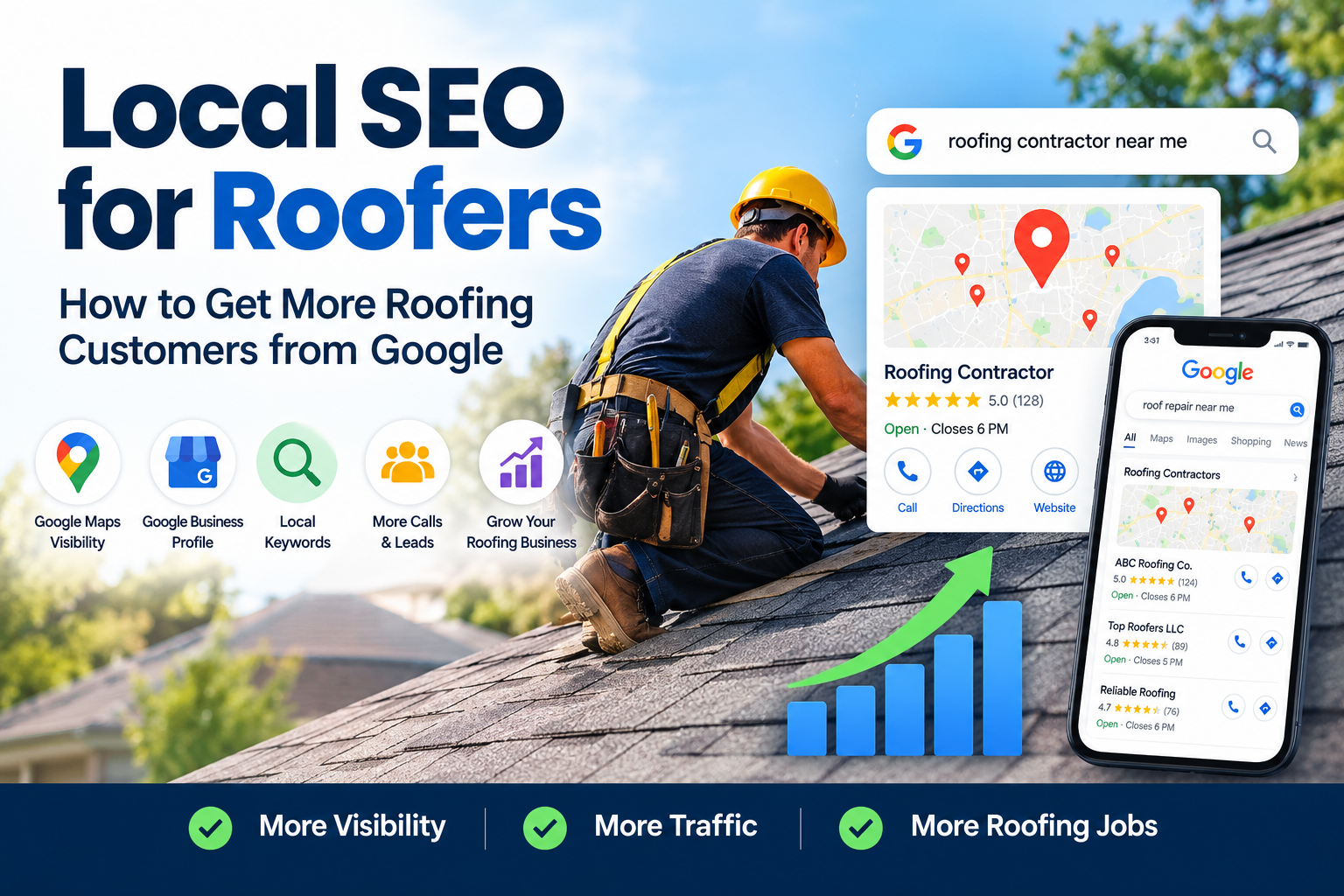
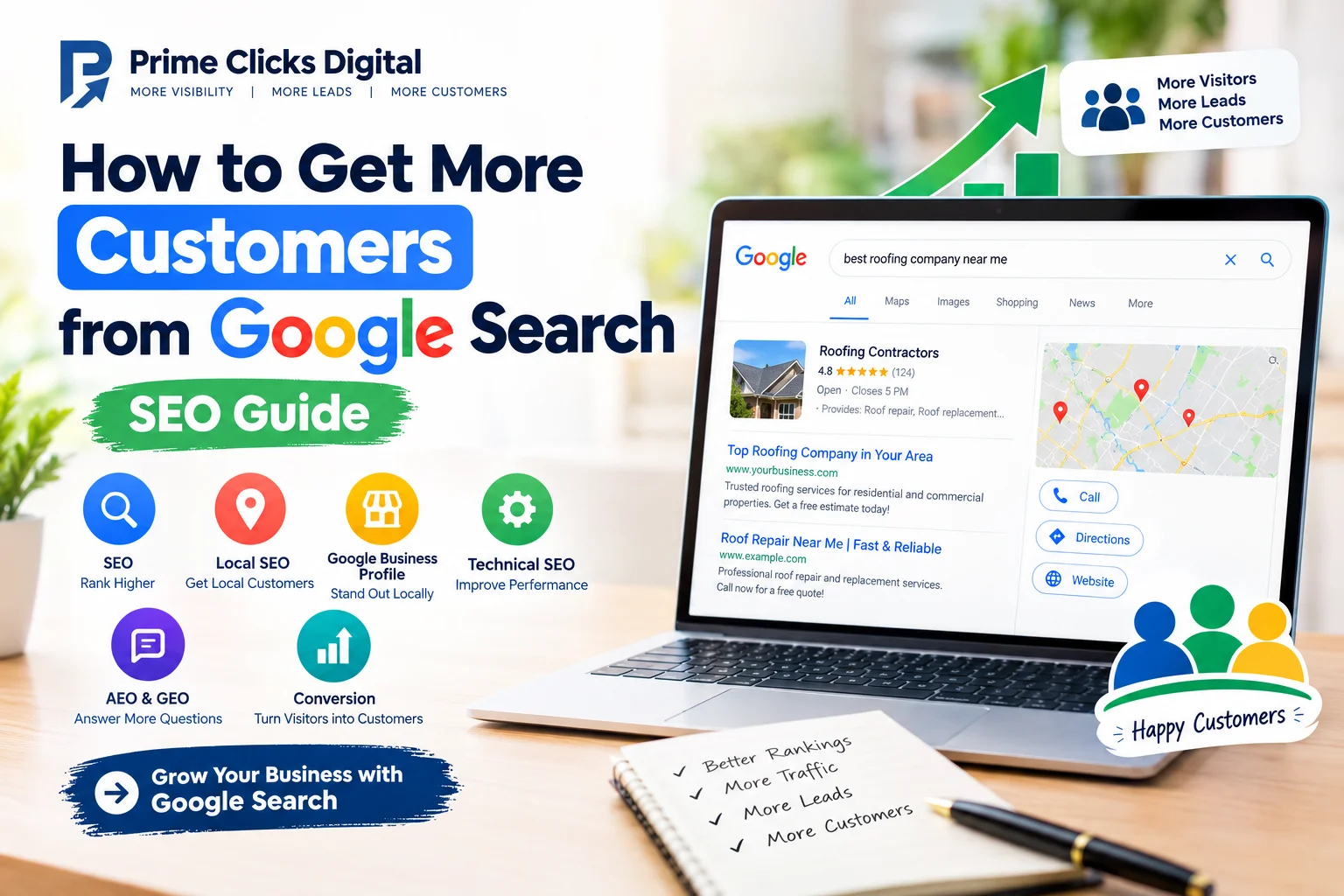
How to Get More Customers from Google Search: A Complete Guide for Small Businesses
Getting more customers from Google Search is one of the most powerful ways to grow a small business online. Every day, potential customers search Google for products, services, local businesses, solutions, reviews, and answers to their problems.
The challenge is not simply getting your website to appear on Google. The real goal is to attract the right visitors, build trust, and turn those visitors into paying customers.
Whether you own a local service business, eCommerce store, professional service company, restaurant, dental practice, roofing company, construction business, or another small business, a strong Google Search strategy can help you generate consistent traffic and leads.
In this guide, you’ll learn how to get more customers from Google Search using SEO, Local SEO, Google Business Profile, content marketing, technical SEO, conversion optimization, AEO, and GEO.
What Does It Mean to Get Customers from Google Search?
Getting customers from Google Search means appearing when people search for products or services related to your business and encouraging those searchers to contact, visit, or purchase from you.
For example, imagine you operate a roofing company in New York.
A potential customer may search:
- Roofing contractors near me
- Best roofing company in New York
- Roof repair near me
- Emergency roof repair
- Roof replacement company
- How much does roof replacement cost?
- Local roofing contractor
If your business appears prominently in these searches, you have an opportunity to turn those searches into leads and customers.
This is why Google Search is more than a traffic source. It can become a customer acquisition channel.
1. Understand What Your Customers Are Searching For
The first step toward getting more customers from Google is understanding your target audience.
Before creating pages or writing blog posts, identify the questions, problems, products, and services your customers are searching for.
For example, a local plumber might target:
- Plumber near me
- Emergency plumber
- Water heater repair
- Drain cleaning
- Bathroom plumbing
- Sewer line repair
- Plumbing company near me
An eCommerce store might target:
- Buy running shoes online
- Best running shoes for beginners
- Affordable running shoes
- Men’s running shoes
- Women’s running shoes
- Lightweight running shoes
The goal is to discover keywords that have commercial or buying intent.
Focus on Search Intent
Search intent describes what a person wants when they perform a search.
There are four common types:
Informational Intent
The user wants information.
Examples:
- What is technical SEO?
- How does Google Search work?
- How often should I service my HVAC?
Navigational Intent
The user wants to find a specific website or business.
Examples:
- Prime Clicks Digital
- Facebook login
- Nike website
Commercial Investigation
The user is researching options before making a decision.
Examples:
- Best SEO company for small businesses
- Best Shopify SEO agency
- Top roofing contractors in New York
Transactional Intent
The user is ready to take action.
Examples:
- Buy SEO services
- Hire a roofing contractor
- Shopify SEO services
- Local SEO agency near me
For generating customers, commercial and transactional keywords are particularly valuable.
2. Perform Keyword Research
Keyword research helps you discover what your potential customers search for on Google.
Instead of choosing keywords simply because they have high search volume, consider:
- Search intent
- Competition
- Relevance
- Location
- Buying intent
- Business value
For a small business, ranking for a highly relevant keyword with 100 searches per month can sometimes be more valuable than ranking for a broad keyword with thousands of searches.
For example:
“SEO”
is extremely broad.
But:
“local SEO company for small business”
has much stronger commercial intent.
Create Keyword Groups
Organize your keywords into groups such as:
Primary service keywords
- Local SEO
- WordPress SEO
- Shopify SEO
- WooCommerce SEO
Location keywords
- Local SEO company in New York
- SEO agency in Los Angeles
- SEO services for businesses in Chicago
Problem-based keywords
- Website not ranking on Google
- Low Google traffic
- Website SEO problems
- Google ranking improvement
Question keywords
- How to rank higher on Google
- How to get more customers from Google
- How does Local SEO work?
This keyword structure can help you build a complete SEO strategy.
3. Optimize Your Website for Google
Your website is one of the most important assets for generating customers from Google Search.
Your website should clearly communicate:
- What you offer
- Who you help
- Where you operate
- Why customers should trust you
- How customers can contact you
Every important service should have a dedicated page.
For example, an SEO agency might have:
- Local SEO
- Google Business Profile Optimization
- WordPress SEO
- Shopify SEO
- WooCommerce SEO
- Technical SEO
- SEO Audit
- Website Design
- GEO & AEO
- AI Search Visibility
This makes it easier for both Google and potential customers to understand your services.
4. Create High-Quality Service Pages
Your service pages should not be simple pages containing a few paragraphs.
A strong service page should answer the questions a potential customer has before hiring you.
Include:
- Clear headline
- Service description
- Benefits
- Problems you solve
- Your process
- Features
- Case studies
- Testimonials
- FAQs
- Relevant images
- Strong calls-to-action
- Contact information
For example, instead of simply writing:
“We provide Local SEO services.”
explain:
- How Local SEO works
- How you optimize Google Business Profile
- How you improve local rankings
- How you build relevant citations
- How you optimize local landing pages
- How you improve NAP consistency
- How you use local content
- How you track results
This gives Google and users more useful information.
5. Optimize Your On-Page SEO
On-page SEO helps search engines understand your pages.
Important elements include:
SEO Title
Your title should clearly describe the page and naturally include the primary keyword.
Example:
Local SEO Services for Small Businesses | Prime Clicks Digital
Meta Description
Write a compelling description that explains the value of the page and encourages users to click.
URL
Keep URLs short and descriptive.
Example:
/local-seo/
is better than a complicated URL containing unnecessary numbers or parameters.
Headings
Use a logical heading structure:
- H1 for the main topic
- H2 for major sections
- H3 for supporting sections
Images
Use descriptive image file names and relevant alt text.
Internal Links
Link related pages together.
For example:
Your Local SEO page can link to:
- Google Business Profile Optimization
- Technical SEO
- SEO Audit
- GEO & AEO
Internal linking helps users navigate your website and helps search engines discover related content.
6. Build a Strong Google Business Profile
If you operate a local business, Google Business Profile is essential.
Your Google Business Profile can help your business appear in:
- Google Maps
- Local Pack
- Local Search
- Business-related searches
Make sure your profile includes accurate:
- Business name
- Address
- Phone number
- Website
- Business category
- Service areas
- Business hours
- Services
- Photos
- Business description
Keep your information consistent across your website and other online directories.
Add Services
List your main services clearly.
For example, a dental practice might include:
- Dental Cleaning
- Teeth Whitening
- Dental Implants
- Emergency Dentistry
- Cosmetic Dentistry
This gives Google additional information about what your business offers.
7. Get More Customer Reviews
Reviews are extremely important for local businesses.
Potential customers often compare businesses before contacting one.
Encourage satisfied customers to leave honest reviews about their experience.
Do not buy fake reviews or manipulate customers into posting misleading reviews.
Instead, create a simple review request process.
For example, after completing a successful project, send your customer a message asking whether they would be willing to share their experience.
Respond professionally to both positive and negative reviews.
A thoughtful response to a negative review can demonstrate that your business cares about customers.
8. Create Content That Answers Customer Questions
Blog content can help you attract people before they are ready to buy.
Instead of publishing random articles, create content based on real customer questions.
For example, a roofing company could publish:
- How Much Does Roof Replacement Cost?
- How Long Does a Roof Last?
- Signs You Need a New Roof
- Roof Repair vs. Roof Replacement
- How to Choose a Roofing Contractor
A dental practice could publish:
- How Often Should You Visit the Dentist?
- How Long Does Teeth Whitening Last?
- What Are the Benefits of Dental Implants?
- How to Prevent Tooth Decay
This type of content can introduce your business to potential customers during the research stage.
9. Use Topic Clusters
Instead of writing unrelated blog posts, build content around important topics.
For example, suppose your main service is Local SEO.
Your main service page could be:
Local SEO Services
Supporting articles could include:
- What Is Local SEO?
- How to Optimize Google Business Profile
- How to Get More Google Reviews
- Local Citation Guide
- Local SEO Checklist
- How to Rank in Google Maps
- Local SEO for Small Businesses
Then link these articles back to the main Local SEO service page.
This creates a strong topical structure.
10. Improve Your Website’s Technical SEO
Even excellent content may struggle if your website has technical problems.
Important technical SEO factors include:
- Mobile responsiveness
- Fast loading speed
- HTTPS
- Crawlability
- Indexability
- XML sitemap
- Robots.txt
- Canonical URLs
- Broken links
- Redirects
- Duplicate content
- Structured data
- Core Web Vitals
Make sure Google can easily crawl, understand, and index your important pages.
Improve Page Speed
Slow websites can create a poor user experience.
Consider optimizing:
- Images
- CSS
- JavaScript
- Fonts
- Plugins
- Server performance
- Browser caching
Use modern image formats such as WebP where appropriate.
11. Make Your Website Mobile-Friendly
Many users search Google from smartphones.
Your website should work properly on:
- Smartphones
- Tablets
- Laptops
- Desktop computers
Check:
- Font size
- Button size
- Navigation
- Images
- Forms
- Page spacing
- Mobile loading speed
A customer should be able to contact your business easily from a mobile device.
12. Add Strong Calls-to-Action
Getting website traffic is not enough.
You need to turn visitors into leads.
Add clear calls-to-action throughout your website.
Examples:
- Get a Free SEO Audit
- Request a Quote
- Book a Consultation
- Call Now
- Get Started
- Contact Us
- Get a Free Website Analysis
Make the next step obvious.
For service businesses, your phone number and contact button should be easy to find.
13. Build Trust on Your Website
People don’t automatically trust every business they find on Google.
Your website should demonstrate credibility.
Add:
- Customer testimonials
- Case studies
- Reviews
- Portfolio
- Certifications
- Experience
- Before-and-after results
- Client logos where appropriate
- Clear contact information
- About Us page
Case studies are particularly powerful because they show how you solved real customer problems.
For example:
Problem → Strategy → Implementation → Results
This structure helps potential customers understand your value.
14. Use Local SEO for Location-Based Customers
If your business serves a specific geographic area, Local SEO can be one of the most effective ways to generate customers.
Create location-specific pages when they provide genuine value.
For example:
- Local SEO in New York
- Local SEO in Los Angeles
- Local SEO in Chicago
For a roofing company:
- Roofing Contractor in Brooklyn
- Roof Repair in Queens
- Roofing Company in Manhattan
Avoid creating hundreds of nearly identical pages just to target locations.
Each location page should contain genuinely useful, locally relevant information.
15. Build Quality Local Citations
Local citations are online mentions of your business information.
Important information includes:
- Business name
- Address
- Phone number
- Website
Create profiles on relevant and trustworthy directories.
The goal is not to create thousands of low-quality backlinks.
Focus on relevant, trustworthy, and consistent listings.
16. Build High-Quality Backlinks
Backlinks remain an important part of SEO.
A backlink is a link from another website to your website.
But quality matters more than quantity.
Good opportunities may include:
- Industry websites
- Local organizations
- Business directories
- Professional associations
- Local news websites
- Relevant blogs
- Partnerships
- Digital PR
- Guest contributions
Avoid spammy link-building schemes.
One relevant, authoritative backlink can be more valuable than many low-quality links.
17. Optimize for Featured Snippets and AEO
Search is changing.
People increasingly ask complete questions instead of typing only short keywords.
This makes Answer Engine Optimization (AEO) increasingly important.
Create content that directly answers questions.
For example:
Question:
What is Local SEO?
Answer:
Local SEO is the process of optimizing a business’s online presence so it can appear more prominently in location-based Google searches and attract customers from specific geographic areas.
Then expand on the topic with detailed information.
Use:
- Clear questions
- Short direct answers
- Lists
- Tables
- Step-by-step instructions
- FAQs
This structure makes content easier for search engines and users to understand.
18. Optimize for AI Search and GEO
Search behavior is evolving beyond traditional Google results.
People increasingly use AI-powered search and conversational systems to discover businesses and information.
Generative Engine Optimization (GEO) focuses on making your content easier for AI-powered search systems to understand, reference, and summarize.
To improve your GEO strategy:
- Publish original information
- Demonstrate expertise
- Clearly explain your services
- Answer specific questions
- Use structured content
- Include factual details
- Build authority
- Maintain consistent business information
- Create helpful, people-first content
Do not create content only for algorithms.
The best approach is to create genuinely useful information that serves customers first.
19. Track Google Search Performance
You cannot improve what you don’t measure.
Use tools such as Google Search Console and Google Analytics to monitor performance.
Important metrics include:
Impressions
How often your pages appear in search results.
Clicks
How many users visit your website from Google.
Click-Through Rate
The percentage of searchers who click your result.
Average Position
Your average ranking position for searches.
Organic Traffic
Visitors arriving through search engines.
Conversions
The number of visitors who become leads or customers.
For a service business, conversions could include:
- Contact form submissions
- Phone calls
- Quote requests
- Consultation bookings
- WhatsApp messages
- Purchases
Traffic is useful, but qualified traffic and conversions are more important.
20. Improve Your Click-Through Rate
Suppose your page receives thousands of impressions but very few clicks.
Your problem may not be ranking alone.
Your search result may not be compelling enough.
Improve:
- SEO titles
- Meta descriptions
- Search intent alignment
- Value propositions
- Brand messaging
For example, instead of:
SEO Services | Company Name
you might use:
SEO Services for Small Businesses | Get More Google Leads
Make the title relevant and attractive without using misleading clickbait.
21. Refresh Old Content
SEO is not a one-time project.
Search results, competitors, customer questions, and industry trends change.
Review older content regularly.
Update:
- Statistics
- Examples
- Screenshots
- Links
- Keywords
- FAQs
- Service information
- Outdated recommendations
Improve thin or outdated articles instead of continually publishing new content without maintaining your existing pages.
22. Create a Conversion-Focused Homepage
Your homepage should immediately answer:
What do you do?
Who do you help?
Where do you operate?
Why should customers choose you?
What should they do next?
A strong homepage can include:
- Clear headline
- Short value proposition
- Primary CTA
- Services
- Benefits
- Trust signals
- Case studies
- Testimonials
- FAQs
- Contact section
Your homepage should guide visitors toward taking action.
23. Use Schema Markup
Structured data, commonly known as schema markup, helps search engines understand information on your website.
Depending on your business and page type, relevant schema may include:
- Organization
- LocalBusiness
- Service
- Product
- Article
- Breadcrumb
- FAQ
Only use schema that accurately represents the visible information on your page.
Schema is not a guaranteed ranking shortcut, but it can help search engines better understand your content and may support eligible search enhancements.
24. Build a Complete Google Search Customer Journey
The most effective SEO strategy considers the entire customer journey.
Stage 1: Discovery
The customer searches for information.
Example:
How to fix a leaking roof
Your educational blog post can attract them.
Stage 2: Research
They search:
Best roof repair company near me
Your Local SEO and Google Business Profile presence can help.
Stage 3: Comparison
They compare:
- Reviews
- Pricing
- Experience
- Services
- Case studies
Your website should provide this information.
Stage 4: Decision
They are ready to contact a company.
Your CTA should make it easy to:
- Call
- Request a quote
- Book an appointment
- Send a message
Stage 5: Customer
After the customer completes the service, encourage an honest review and maintain the relationship.
This creates a complete SEO-driven customer acquisition system.
25. Common Google Search Mistakes to Avoid
Many businesses make mistakes that prevent them from getting results.
Mistake 1: Targeting Only High-Volume Keywords
High-volume keywords are often extremely competitive.
Focus on relevant keywords that can generate business.
Mistake 2: Ignoring Local SEO
If you serve a specific city or area, ignoring Local SEO can mean missing valuable customers.
Mistake 3: Publishing Low-Quality Content
Publishing hundreds of weak AI-generated articles is not a replacement for useful content.
Focus on originality, expertise, accuracy, and customer value.
Mistake 4: Buying Spammy Backlinks
Low-quality links can create SEO risks and rarely provide sustainable value.
Mistake 5: Ignoring Mobile Users
A website that works poorly on smartphones can lose potential customers.
Mistake 6: No Clear CTA
Visitors may leave if they don’t know what to do next.
Mistake 7: Not Tracking Conversions
Ranking and traffic numbers don’t tell the whole story.
Track actual leads and customers.
Google Search Customer Growth Checklist
Use this checklist to improve your website’s ability to generate customers.
Keyword Research
- Identify target customers
- Research relevant keywords
- Analyze search intent
- Find commercial keywords
- Find location-based keywords
- Identify customer questions
Website SEO
- Optimize title tags
- Write compelling meta descriptions
- Improve headings
- Optimize URLs
- Add internal links
- Optimize images
- Improve content quality
Technical SEO
- Improve website speed
- Make the website mobile-friendly
- Fix broken links
- Check indexing
- Submit XML sitemap
- Review robots.txt
- Implement HTTPS
- Monitor Core Web Vitals
- Add appropriate structured data
Local SEO
- Optimize Google Business Profile
- Add accurate business information
- Add services
- Upload quality photos
- Collect genuine reviews
- Respond to reviews
- Build relevant local citations
- Create useful local content
Content
- Publish customer-focused blog posts
- Answer common questions
- Create service guides
- Create comparison content
- Update old articles
- Build topic clusters
- Add FAQs
Conversion Optimization
- Add clear CTAs
- Display phone number
- Add contact forms
- Show testimonials
- Add case studies
- Display trust signals
- Make mobile contact easy
AEO & GEO
- Answer questions clearly
- Use structured content
- Provide original insights
- Demonstrate expertise
- Keep business information consistent
- Create content useful for both people and AI-powered search
How Long Does It Take to Get Customers from Google?
SEO results vary depending on:
- Competition
- Industry
- Website authority
- Current rankings
- Website quality
- Location
- Content quality
- Backlink profile
- Technical issues
- Search demand
Some businesses may see improvements within a few months, while competitive industries can require significantly longer.
SEO should be viewed as a long-term investment rather than an overnight solution.
The objective is to build a sustainable source of qualified traffic and leads.
Final Thoughts: Turn Google Search into a Customer Acquisition Channel
Getting more customers from Google Search requires more than simply adding keywords to your website.
You need a complete strategy that combines:
Keyword Research + On-Page SEO + Technical SEO + Local SEO + Google Business Profile + Content Marketing + Conversion Optimization + AEO + GEO
Start by understanding what your customers are searching for.
Then create useful content and optimized service pages that answer their questions and demonstrate your expertise.
Make your website fast, mobile-friendly, trustworthy, and easy to navigate. Optimize your Google Business Profile if you serve local customers, collect genuine reviews, build relevant authority, and continuously monitor your performance.
Most importantly, don’t focus only on rankings.
The real goal of SEO is to turn search visibility into qualified visitors, leads, sales, and long-term customers.
If your website is receiving impressions but not enough clicks or customers, it may be time for a complete SEO and conversion analysis.
At Prime Clicks Digital, we help businesses improve their online visibility through Local SEO, Google Business Profile Optimization, WordPress SEO, Shopify SEO, WooCommerce SEO, Technical SEO, SEO Audits, Website Design, GEO & AEO, and AI Search Visibility.
A well-optimized website can help your business get discovered by the right people at the right time—and turn Google Search into a consistent source of new customers.
Ready to Get More Customers from Google?
Start by auditing your website, identifying your highest-value keywords, fixing technical SEO problems, improving your service pages, and creating content that answers real customer questions.
Get your website in front of the right customers—and turn Google searches into business opportunities.
Frequently Asked Questions
1. How can I get more customers from Google Search?
Improve your SEO, target relevant commercial keywords, optimize your website, create useful content, optimize your Google Business Profile, build authority, and improve your conversion process.
2. How long does SEO take to generate customers?
SEO timelines vary depending on competition, website authority, industry, location, and the quality of the SEO strategy. Sustainable results generally require consistent work over time.
3. Is Google Business Profile important for local businesses?
Yes. A properly optimized Google Business Profile can help eligible local businesses appear in Google Search and Google Maps and provide customers with important business information.
4. Should small businesses invest in SEO?
Yes. SEO can be particularly valuable for small businesses because it can help them reach customers who are actively searching for their products or services.
5. What is the difference between SEO, AEO, and GEO?
SEO focuses on improving visibility in search engines. AEO focuses on providing clear answers to search questions and answer-oriented experiences. GEO focuses on improving how content can be understood and surfaced by generative and AI-powered search systems.
6. How do I know if my SEO strategy is working?
Monitor impressions, clicks, rankings, organic traffic, phone calls, contact forms, quote requests, purchases, and other meaningful conversions.
7. Can a new website rank on Google?
Yes. A new website can rank, but the timeline depends on competition, content quality, technical SEO, authority, relevance, and the search queries being targeted.
8. What is the most important SEO factor for getting customers?
There isn’t one single factor. Successful SEO combines relevance, helpful content, technical accessibility, authority, user experience, local signals where appropriate, and a strong conversion strategy.
Frequently Asked Questions
1. How can I get more customers from Google Search?
You can attract more customers by improving your website’s SEO, targeting high-intent keywords, optimizing your Google Business Profile, creating helpful content, improving website speed, building authority, and adding clear calls-to-action.
2. How long does it take to get customers from Google?
SEO results vary depending on your industry, competition, website authority, location, and current SEO condition. Consistent optimization and quality content can help build sustainable organic visibility over time.
3. Why is my website getting Google impressions but very few clicks?
Low clicks can be caused by poor search rankings, weak SEO titles, unappealing meta descriptions, incorrect search intent targeting, or strong competition in the search results. Improving your titles, descriptions, content, and overall SEO strategy can help increase your click-through rate.
4. Is Local SEO important for small businesses?
Yes. Local SEO can help businesses reach customers searching for services in their area. Optimizing your Google Business Profile, website, local content, reviews, citations, and location signals can improve local visibility.
5. How important is Google Business Profile for getting customers?
Google Business Profile is an important part of Local SEO. A properly optimized profile can help eligible businesses appear in Google Search and Google Maps when potential customers search for relevant local products or services.
6. Can SEO help my business generate leads?
Yes. A well-planned SEO strategy can attract people who are actively searching for your products or services. Combining SEO with strong service pages, trust signals, and clear calls-to-action can help convert organic visitors into leads.
7. What is Technical SEO?
Technical SEO focuses on improving the technical foundation of a website so search engines can efficiently crawl, understand, and index its content. It can include website speed, mobile usability, indexing, XML sitemaps, redirects, broken links, structured data, and Core Web Vitals.
8. What are AEO and GEO?
AEO, or Answer Engine Optimization, focuses on creating content that clearly answers users’ questions. GEO, or Generative Engine Optimization, focuses on making content easier for AI-powered search and generative systems to understand and potentially surface.
9. Do you provide SEO services for WordPress and WooCommerce websites?
Yes. We provide WordPress SEO and WooCommerce SEO services designed to improve search visibility, technical performance, on-page optimization, and organic growth.
10. Do you provide Shopify SEO services?
Yes. We provide Shopify SEO services including keyword research, on-page optimization, product and collection optimization, technical SEO, structured data, image optimization, and other SEO improvements.
11. Can you optimize an existing website instead of building a new one?
Yes. We can audit your existing website, identify SEO, technical, content, UX, and conversion issues, and recommend or implement improvements based on your business goals.
12. How can I start improving my Google Search visibility?
Start with a complete website and SEO audit. Identify your most valuable keywords, fix technical issues, improve important service pages, optimize your Google Business Profile if applicable, publish helpful content, and continuously monitor your search performance.
Our Services
At Prime Clicks Digital, we provide SEO, website, and AI-search optimization services designed to help businesses improve online visibility, attract qualified visitors, generate leads, and grow.
1. Local SEO
Improve your visibility in local Google Search and Maps with a strategic Local SEO campaign focused on relevant local customers.
2. Google Business Profile Optimization
Optimize your Google Business Profile with accurate business information, services, categories, content, and local SEO best practices.
3. WordPress SEO
Improve WordPress website visibility through keyword research, on-page SEO, technical optimization, content improvements, internal linking, schema, and performance optimization.
4. Shopify SEO
Optimize Shopify stores to improve organic visibility, product rankings, collection pages, technical SEO, and search-driven sales.
5. WooCommerce SEO
Optimize WooCommerce websites and product pages to improve search visibility, product discoverability, technical performance, and organic traffic.
6. Technical SEO
Identify and fix technical issues affecting crawling, indexing, website speed, mobile performance, internal linking, redirects, structured data, and overall search performance.
7. SEO Audit
Get a detailed analysis of your website’s SEO health, including technical SEO, on-page SEO, content, keywords, performance, links, and opportunities for improvement.
8. Website Design
Create professional, responsive, user-friendly websites designed with SEO, performance, user experience, and conversion goals in mind.
9. GEO & AEO
Optimize website content to provide clear answers and improve visibility across modern search experiences, including answer engines and generative search.
10. AI Search Visibility / AI SEO
Improve your digital presence for AI-powered search experiences by creating authoritative, structured, helpful, and easily understandable content that supports modern discovery.
Why Choose Prime Clicks Digital?
We focus on more than rankings. Our goal is to help businesses build a stronger online presence that can attract qualified traffic, leads, and customers.
Our approach combines:
- Search Engine Optimization
- Local SEO
- Google Business Profile Optimization
- Technical SEO
- Content Optimization
- Website Design
- AEO
- GEO
- AI Search Visibility
- Conversion-focused strategies
Get your business found by the right customers.
Request a Free SEO Audit to identify potential technical, content, SEO, GEO, and AEO opportunities for your website.
Website: https://www.primeclicksdigital.com/
Email: info@primeclicksdigital.com
WhatsApp: +8801779636906