How to Optimize Your Website for ChatGPT and AI Search: A Beginner’s Guide
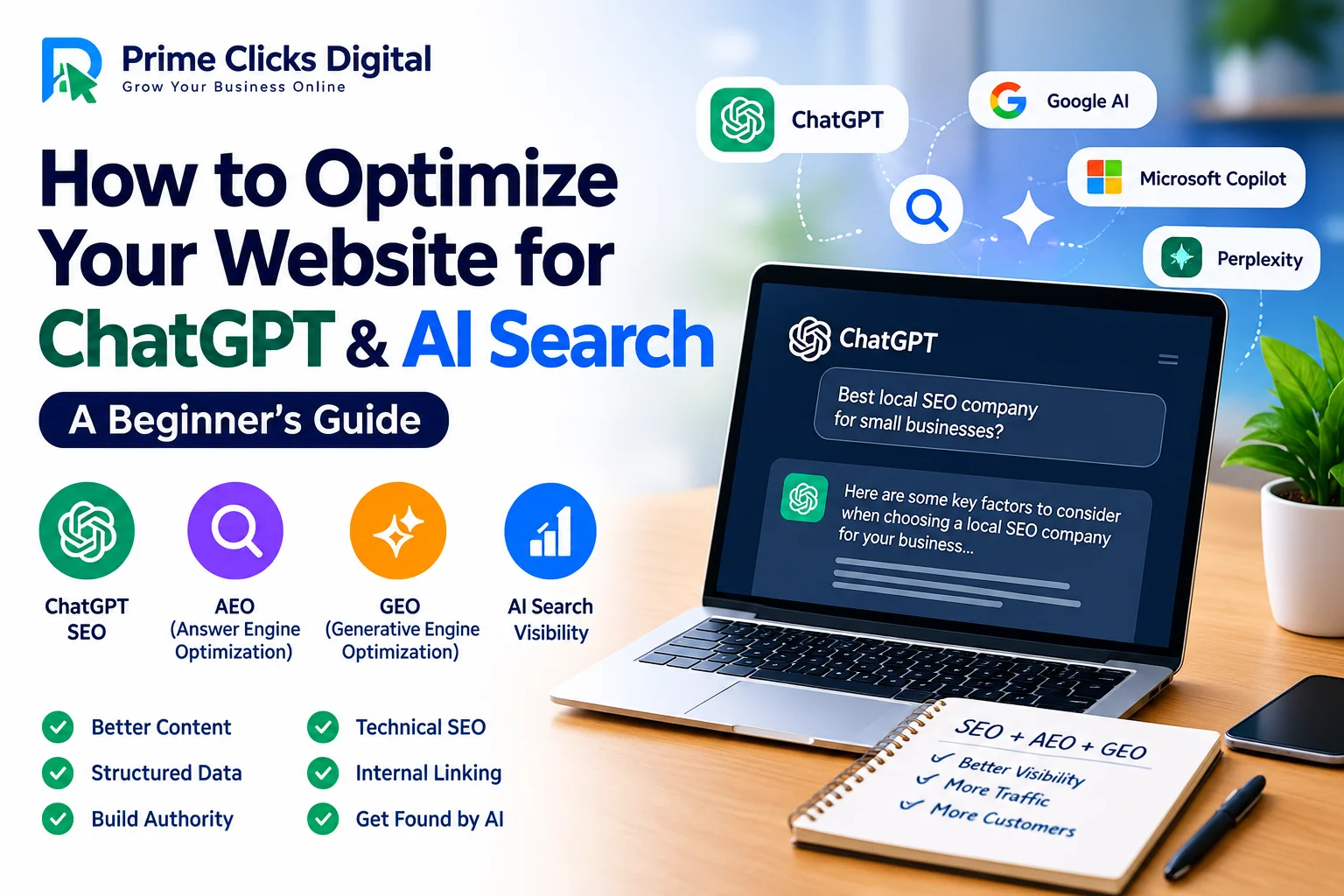
Search is changing rapidly. For many years, businesses focused mainly on ranking their websites on Google and other traditional search engines. Today, people are also using AI-powered platforms such as ChatGPT, Google AI features, Microsoft Copilot, Perplexity, and other generative search tools to find answers, products, services, businesses, and recommendations.
This change creates a new opportunity for website owners.
Instead of optimizing your website only for traditional search engine rankings, you can also optimize your content and website structure so that AI systems can better understand, trust, and potentially reference your business.
This process is commonly associated with Generative Engine Optimization (GEO), Answer Engine Optimization (AEO), and AI Search Optimization.
In this beginner-friendly guide, you will learn how to optimize your website for ChatGPT and AI search, improve your content structure, build authority, use structured data, and create content that is easier for both search engines and AI systems to understand.
What Is AI Search Optimization?
AI Search Optimization is the process of improving your website’s content, structure, authority, and technical signals so that AI-powered search systems can better understand your business and information.
Traditional SEO primarily focuses on improving visibility in search engine results pages.
AI search optimization goes a step further.
It focuses on making your website:
- Easy for machines to understand
- Easy for users to read
- Clearly organized
- Trustworthy and authoritative
- Relevant to specific questions
- Supported by useful information
- Consistent across the web
- Technically accessible
For example, someone might search Google for:
“Best local SEO company for small businesses in the USA.”
But another person may ask ChatGPT:
“What should a small business look for when hiring a local SEO agency?”
AI systems can generate answers based on information they can access, their training, search/retrieval systems, and other available sources.
Your goal is to make your website a useful and trustworthy source of information.
What Are GEO, AEO, and AI SEO?
You may see several terms used when researching AI search optimization.
Understanding the difference can make your strategy much clearer.
SEO – Search Engine Optimization
SEO is the process of improving a website so that it can perform better in traditional search engines.
SEO includes:
- Keyword research
- On-page optimization
- Technical SEO
- Internal linking
- Content optimization
- Backlinks
- Website speed
- Mobile optimization
- Schema markup
- User experience
SEO remains important because AI search optimization does not replace the fundamentals of having a high-quality website.
AEO – Answer Engine Optimization
AEO focuses on optimizing content so that it can provide direct answers to questions.
For example:
Question: What is local SEO?
A well-optimized answer could begin:
Local SEO is the process of optimizing a business’s online presence to improve visibility in geographically relevant search results, including Google Maps and local search results.
This format gives users a clear answer quickly.
AEO strategies often include:
- Question-based content
- FAQs
- Short direct answers
- Structured headings
- Lists
- Step-by-step explanations
- Clear definitions
GEO – Generative Engine Optimization
GEO, or Generative Engine Optimization, focuses on improving a website’s ability to be understood and potentially represented in AI-generated responses.
GEO can include:
- Creating authoritative content
- Demonstrating expertise
- Providing specific information
- Building online mentions
- Improving entity consistency
- Using structured content
- Supporting claims with reliable sources
- Creating comprehensive topic coverage
GEO and traditional SEO overlap significantly.
A strong SEO foundation can support your AI search visibility.
Why Should You Optimize Your Website for ChatGPT and AI Search?
AI-powered search is becoming an increasingly important way people discover information.
Users are asking AI tools questions about:
- Businesses
- Products
- Services
- Software
- Restaurants
- Travel
- Education
- Marketing
- Technology
- Local services
- Health information
- Shopping decisions
This means businesses should think beyond ranking for individual keywords.
Instead, think about the questions your potential customers are asking.
For example, a plumber may traditionally target:
“plumber near me”
But potential customers may also ask:
“How do I know if I need emergency plumbing?”
“How much does a plumbing repair usually cost?”
“What should I check before hiring a plumber?”
Creating helpful content around these questions can establish your website as a useful resource.
Step 1: Build a Strong SEO Foundation
Before focusing heavily on AI search, make sure your basic SEO is correct.
Your website should have:
- A crawlable structure
- Mobile-friendly design
- Fast loading pages
- HTTPS
- Clear navigation
- Optimized titles
- Meta descriptions
- Proper heading structure
- Internal links
- High-quality content
- Descriptive URLs
- XML sitemap
- Proper indexing
- Useful images with descriptive alt text
AI optimization does not mean ignoring traditional SEO.
A technically weak website can make it more difficult for search engines and AI-powered systems to discover and understand your content.
Step 2: Create High-Quality Helpful Content
One of the most important AI search optimization strategies is creating content that genuinely helps users.
Avoid creating articles simply to insert keywords.
Instead, answer real questions.
For example, instead of writing:
“Local SEO services are important because local SEO services help businesses with local SEO…”
Create useful content such as:
“Local SEO helps businesses appear when customers search for products or services in a specific geographic area. It can involve Google Business Profile optimization, local citations, location-based content, reviews, and technical SEO.”
The second version provides useful information naturally.
Step 3: Answer Questions Directly
AI systems need to understand what your content is actually about.
One simple strategy is to use question-based headings.
For example:
What Is Technical SEO?
Technical SEO focuses on improving the technical elements of a website so search engines can crawl, understand, and index its pages effectively.
Why Is Technical SEO Important?
Technical SEO can help search engines discover website content, understand page relationships, and provide a better experience for visitors.
How Can I Improve Technical SEO?
You can improve technical SEO by addressing crawlability, indexing, site speed, mobile usability, redirects, broken links, structured data, and website architecture.
This structure is easy for humans to read and easy for automated systems to interpret.
Step 4: Use Clear Heading Structure
Your content should have a logical hierarchy.
Use:
H1 for the primary page topic.
H2 for major sections.
H3 for supporting subsections.
For example:
H1: How to Optimize Your Website for AI Search
H2: What Is AI Search Optimization?
H2: Why AI Search Matters
H2: How to Optimize Your Website
H3: Improve Content Quality
H3: Add Structured Data
H3: Build Authority
This creates a clear relationship between different parts of your content.
Step 5: Create Topic Clusters
Instead of publishing random blog posts, create groups of related content.
For example, a digital marketing agency could create a main topic:
AI Search Optimization
Then publish supporting articles such as:
- What Is GEO?
- What Is AEO?
- How Does ChatGPT Search Work?
- How to Optimize Content for AI Search
- What Is AI SEO?
- How to Improve AI Search Visibility
- SEO vs GEO vs AEO
- How Businesses Can Prepare for AI Search
Link these articles together.
This creates a stronger topical structure.
Step 6: Use Internal Linking
Internal links help users and search engines discover related content.
For example, if you write an article about GEO, you could link to your pages about:
- SEO
- AEO
- Technical SEO
- Local SEO
- AI Search Visibility
Use descriptive anchor text.
Instead of:
Click here
Use:
learn more about Generative Engine Optimization
Descriptive anchor text provides more context.
Step 7: Add FAQ Sections
Frequently Asked Questions can make your content more useful.
For example:
What is GEO?
GEO stands for Generative Engine Optimization. It refers to strategies designed to improve how a website’s content is understood and potentially represented by generative AI and AI-powered search systems.
Can SEO help with AI search?
Yes. Strong technical SEO, high-quality content, clear site structure, authority, and accessibility can support visibility across modern search experiences.
Does adding FAQ schema guarantee AI visibility?
No. Structured data helps machines understand content, but it does not guarantee that a page will appear in AI-generated responses.
That last point is especially important.
There is no guaranteed formula for being mentioned by ChatGPT or another AI system.
Step 8: Use Structured Data and Schema Markup
Schema markup helps communicate information about your website to search engines.
Common schema types include:
- Organization
- LocalBusiness
- Service
- Article
- BlogPosting
- Product
- BreadcrumbList
- FAQPage
- Person
- WebSite
For example, a business website may use Organization schema to describe:
- Business name
- Website
- Logo
- Social profiles
- Contact information
A service page may use Service schema to describe:
- Service name
- Service description
- Provider
- Service area
However, schema should accurately represent visible or relevant information on the page.
Never add false information simply because you want to influence search results.
Step 9: Establish Your Business Entity Clearly
AI systems need context.
Make sure your business information is consistent across your website and important online profiles.
For example:
Business Name: Prime Clicks Digital
Website: Prime Clicks Digital
Services: Local SEO, Google Business Profile, WordPress SEO, Shopify SEO, WooCommerce SEO, Technical SEO, SEO Audit, Website Design, GEO & AEO, AI Search Visibility
Your business information should be consistent wherever your company is represented online.
Pay attention to:
- Business name
- Website URL
- Business description
- Services
- Location/service area
- Contact information
- Social profiles
Consistency can help establish a clearer online entity.
Step 10: Build Online Authority
AI search optimization is not only about your website.
Your business may also be represented across the wider web.
Build legitimate online presence through relevant platforms such as:
- Business directories
- Industry websites
- Professional profiles
- Social media
- Review platforms
- Local business websites
- Relevant publications
- Partnerships
- Guest contributions
The goal should not be to create thousands of low-quality profiles.
Focus on relevant, legitimate, and useful mentions.
Quality is more important than quantity.
Step 11: Get Relevant Backlinks
Backlinks remain an important part of SEO.
A backlink occurs when another website links to your website.
For example, an industry publication might mention your agency and link to your website.
Good backlink opportunities can come from:
- Industry publications
- Local organizations
- Business directories
- Partnerships
- Associations
- Relevant blogs
- Digital PR
- Original research
Avoid mass-produced spam links.
A smaller number of relevant, trustworthy links can be more valuable than large quantities of unrelated links.
Step 12: Demonstrate Experience and Expertise
Your website should show that real people understand the subject.
Consider adding:
- Author information
- Company information
- Case studies
- Portfolio examples
- Client results
- Methodology
- Original research
- Sources
- Credentials where relevant
- Contact information
For an SEO agency, for example, case studies can explain:
Client Problem → Strategy → Implementation → Results
Avoid presenting unsupported claims.
If you report results, explain what was measured and over what period.
Step 13: Create Original Data and Research
Original information can make your website more valuable.
Instead of only repeating information from other websites, consider publishing:
- Industry statistics
- Surveys
- Case studies
- Experiments
- Original research
- Data analysis
- Expert interviews
- Unique frameworks
For example:
“We analyzed 100 local business websites and identified the most common technical SEO issues.”
Original research can provide information that other websites may reference.
Step 14: Optimize for Conversational Search
People often communicate with AI systems differently than they search Google.
Traditional search:
“best SEO agency USA”
Conversational search:
“What should I look for when choosing an SEO agency for a small business?”
Create content that answers natural-language questions.
Think about:
- Who?
- What?
- Why?
- How?
- When?
- Where?
- Which?
- How much?
- What is the difference between…?
This approach can help you cover the language your potential customers actually use.
Step 15: Create Comparison Content
Comparison searches are common.
You can create useful articles such as:
- SEO vs GEO
- SEO vs AEO
- Shopify SEO vs WordPress SEO
- Local SEO vs Traditional SEO
- Google Search vs AI Search
- GEO vs AEO
The content should be factual and useful rather than simply promoting one option.
Explain:
- What each option means
- How they work
- When each may be useful
- Their differences
- Their limitations
Step 16: Optimize Your Service Pages
Many businesses optimize their blog but neglect their service pages.
Your service pages should clearly explain:
- What the service is
- Who it is for
- Problems it solves
- What is included
- How the process works
- Frequently asked questions
- Service areas
- Relevant examples
- How to contact you
For example, a Local SEO service page could include:
Local SEO Services
Who We Help
Our Local SEO Process
Google Business Profile Optimization
Local Keyword Research
Citation Management
Local Content
Review Strategy
Local SEO Audit
Frequently Asked Questions
This creates a comprehensive resource rather than a thin sales page.
Step 17: Optimize Images
Images are also part of website optimization.
Use:
- Descriptive file names
- Relevant alt text
- Proper image dimensions
- Compressed images
- Modern formats such as WebP when appropriate
For example, instead of:
IMG12345.jpg
use:
local-seo-google-business-profile.jpg
Alt text should describe the image naturally.
Do not stuff keywords into alt text.
Step 18: Improve Website Speed
Website performance matters for users and modern search experiences.
Check:
- Core Web Vitals
- Largest Contentful Paint
- Interaction to Next Paint
- Cumulative Layout Shift
- Image sizes
- JavaScript
- CSS
- Caching
- Hosting performance
- Unnecessary plugins
A fast website provides a better user experience.
Step 19: Make Your Website Easy to Crawl
Search engines need to access your content.
Check:
- Robots.txt
- XML sitemap
- Canonical URLs
- Redirects
- Broken links
- Noindex directives
- Crawl errors
- Internal links
Use Google Search Console to monitor indexing and search performance.
Also make sure important pages are not accidentally blocked.
Step 20: Keep Content Fresh
AI search optimization is not a one-time task.
Information changes.
Update important articles when:
- Statistics become outdated
- Products change
- Google changes features
- AI search technology changes
- Your services change
- Industry practices evolve
Add the updated date when appropriate and make meaningful improvements rather than changing dates without updating the content.
Step 21: Build a Strong About Page
Your About page can help explain who operates the website.
Include:
- Company background
- Services
- Experience
- Team information
- Areas served
- Business philosophy
- Contact details
- Relevant achievements
For agencies and service businesses, this can provide important context about the organization behind the content.
Step 22: Optimize Your Google Business Profile
For local businesses, Google Business Profile optimization is an important part of local search visibility.
Keep your profile information accurate.
Pay attention to:
- Business name
- Primary category
- Secondary categories where appropriate
- Business description
- Services
- Website
- Phone
- Hours
- Photos
- Reviews
- Location or service area
Keep information consistent with your website and other legitimate business profiles.
Step 23: Create Content for Different Search Intent
Not every visitor wants the same thing.
Your content should address different types of search intent.
Informational Intent
Example:
What is GEO?
Create educational content.
Commercial Intent
Example:
Best GEO services for small businesses
Create comparison and evaluation content.
Transactional Intent
Example:
Hire an AI SEO agency
Create service pages and strong conversion paths.
Navigational Intent
Example:
Prime Clicks Digital
Make your brand information easy to find.
Understanding search intent helps you create content that matches what users actually need.
Step 24: Don’t Try to “Trick” AI
There is no reliable shortcut that guarantees ChatGPT or another AI system will mention your business.
Avoid tactics such as:
- Keyword stuffing
- Fake reviews
- Fake author profiles
- Hidden text
- Spam backlinks
- Misleading schema
- Automatically generated low-value pages
- False claims
- Manipulated citations
Instead, focus on becoming a genuinely useful source.
Create information that people would want to read, reference, and share.
Step 25: Measure Your AI Search Visibility
AI search visibility can be more difficult to measure than traditional Google rankings.
You can monitor:
- Brand mentions
- Referral traffic
- Organic traffic
- Search impressions
- Search clicks
- Branded searches
- Direct traffic
- Referral sources
- Content engagement
- Leads
- Conversions
You can also periodically test relevant questions across AI platforms to understand how your business or content is represented.
Remember that AI responses can vary depending on the system, query, location, personalization, retrieval sources, and time.
Therefore, one test does not prove permanent visibility.
Common AI Search Optimization Mistakes
1. Focusing Only on Keywords
Keywords matter, but content should answer user needs rather than repeat keywords.
2. Publishing Thin Content
Short content is not automatically bad, but content should provide enough information to satisfy the user’s question.
3. Ignoring Technical SEO
Great content can still struggle if search engines cannot properly crawl or index your website.
4. Creating Fake Authority
Don’t invent credentials, reviews, statistics, or experience.
5. Using Too Much AI-Generated Content Without Review
AI can help with research and drafting, but human review is important for accuracy, originality, context, and usefulness.
6. Ignoring Your Service Pages
Your blog may attract visitors, but your service pages often explain what your business actually offers.
7. Expecting Instant Results
SEO and AI visibility can take time.
Consistent improvement is generally more sustainable than looking for shortcuts.
Beginner-Friendly AI Search Optimization Checklist
Use this checklist when optimizing your website:
Technical SEO
- Website uses HTTPS
- Website is mobile friendly
- Pages load efficiently
- XML sitemap is available
- Important pages are indexable
- Broken links are fixed
- Redirects are correct
- Canonical URLs are configured
On-Page SEO
- Every important page has a clear title
- Meta descriptions are useful
- One clear H1 is used
- H2/H3 headings organize content
- URLs are descriptive
- Images have descriptive alt text
- Internal links connect related pages
Content
- Content answers real questions
- Information is accurate
- Content is original and useful
- Questions are answered directly
- FAQs are included where useful
- Articles are updated when necessary
- Sources are provided where appropriate
AI Search / GEO
- Business information is consistent
- Organization information is clear
- Relevant schema is implemented
- Author information is available where appropriate
- Case studies demonstrate experience
- Relevant online mentions exist
- Content covers important topics comprehensively
- Conversational questions are addressed
The Future of Search Is Becoming More Conversational
Search is evolving from simple keyword matching toward more conversational experiences.
Users can increasingly ask complex questions instead of entering short keywords.
For businesses, this means your website should not only target individual keywords.
It should become a useful information resource.
Think about the complete journey:
Question → Answer → Information → Trust → Business
For example:
A potential customer may first ask:
“What is local SEO?”
Then:
“How does local SEO help a small business?”
Then:
“How much does local SEO cost?”
Then:
“What should I look for in a local SEO agency?”
A strong website can provide useful information at every stage.
Final Thoughts
Optimizing your website for ChatGPT and AI search is not about finding a secret trick to make an AI system mention your business.
It is about making your website easier to understand, more useful, more trustworthy, and more authoritative.
Start with the fundamentals:
- Build a technically strong website.
- Create helpful and original content.
- Answer real customer questions.
- Use clear headings and structure.
- Build topical authority.
- Add relevant structured data.
- Keep business information consistent.
- Build legitimate online authority.
- Create useful service pages.
- Measure and improve your results.
SEO, AEO, GEO, and AI Search Optimization should work together rather than being treated as completely separate strategies.
If your website consistently provides accurate, useful, well-structured information, you give both people and modern search systems better reasons to understand and discover your business.
The goal is simple: create the kind of website that deserves to be found.