
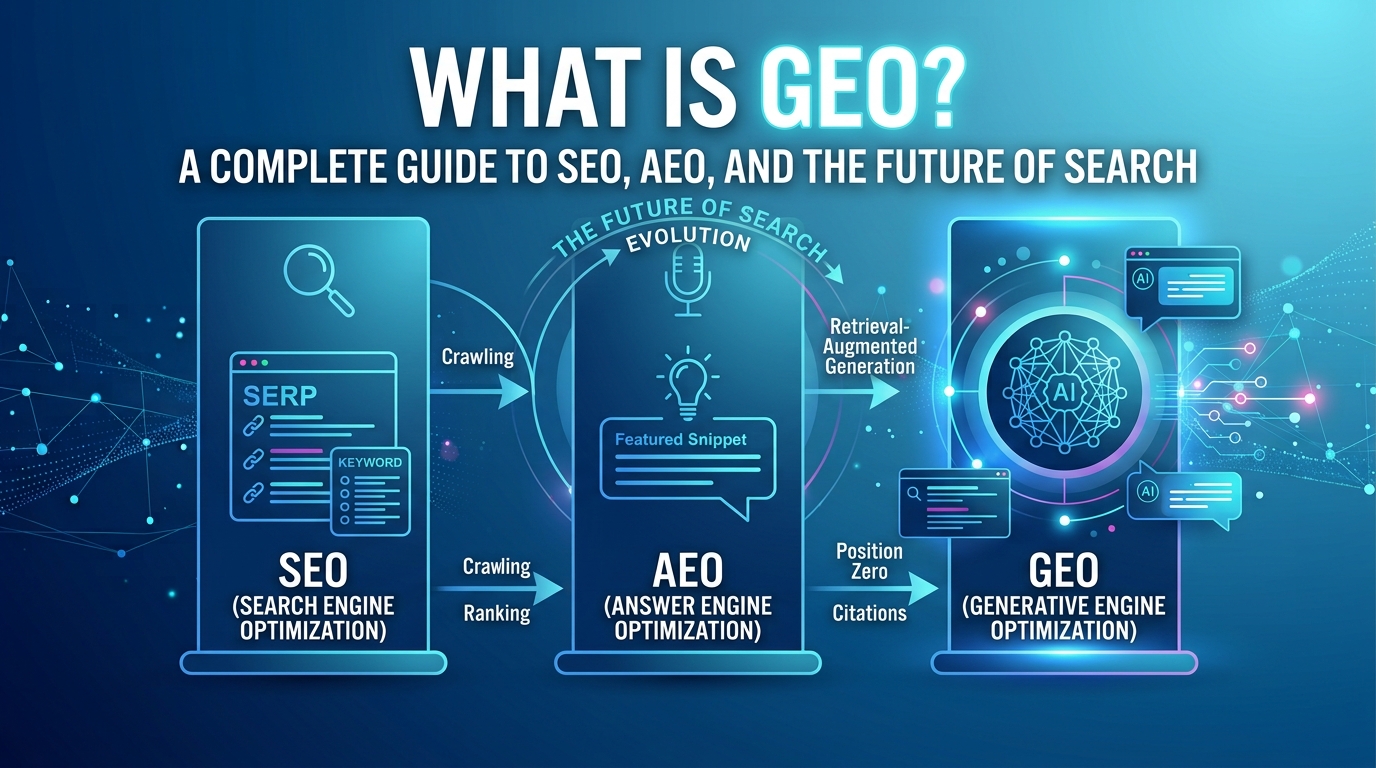
What is Generative Engine Optimization (GEO)? The Complete Guide to SEO, AEO, and the Future of Search
Search is undergoing its most radical transformation since the launch of Google. For over two decades, digital marketing revolved around SEO (Search Engine Optimization)—ranking ten blue links on a search results page. Then came AEO (Answer Engine Optimization), focusing on voice assistants and featured snippets.
Today, we are in the era of GEO (Generative Engine Optimization).
As AI search engines like ChatGPT, Google AI Overviews, Perplexity, Gemini, and Claude directly summarize answers for users, traditional search strategies are no longer enough. To stay visible, content creators and businesses must adapt to how Generative AI models discover, parse, and cite information.
1. What is Generative Engine Optimization (GEO)?
Generative Engine Optimization (GEO) is the practice of structuring, writing, and optimizing digital content so that Large Language Models (LLMs) and AI-driven search engines select, synthesize, and cite your content in their generated responses.
Unlike traditional search engines that crawl web pages to build a keyword index, generative AI engines (such as Perplexity AI, Google Gemini, or ChatGPT with Search) operate on retrieval-augmented generation (RAG). They retrieve content from multiple trustworthy websites across the web, synthesize that information in real-time, and display a cohesive text answer complete with direct citations and source links.
The Shift from Keywords to Context
-
Traditional SEO Goal: Get a specific webpage ranked #1 for a high-volume keyword query (e.g., “best CRM software”).
-
GEO Goal: Ensure your brand, statistics, insights, or solutions are synthesized into the generative response when a user asks a complex natural language query (e.g., “Compare the top 3 CRM tools for a 10-person real estate agency with automated email marketing”).
2. SEO vs. AEO vs. GEO: Understanding the Differences
To master modern digital visibility, you must understand how these three pillars of search optimization coexist and differ.
Search Engine Optimization (SEO)
SEO focuses on improving a site’s visibility on traditional search engine results pages (SERPs). It relies heavily on on-page keywords, technical site performance, internal linking, and earning high-authority backlinks. The user journey typically involves clicking a link and landing on your website.
Answer Engine Optimization (AEO)
AEO emerged with the rise of voice search (Siri, Alexa, Google Assistant) and Google’s Featured Snippets (“Position Zero”). AEO aims to provide immediate, definitive, concise single answers to factual questions (who, what, where, when). It heavily relies on structured data (Schema.org markup), clear Q&A formatting, and short bullet points.
Generative Engine Optimization (GEO)
GEO goes beyond single direct answers or keyword lists. Generative AI engines process multi-faceted, nuanced prompts that require contextual reasoning, comparison, and synthesis. GEO focuses on content credibility, citation density, unique data points, authority signals, and semantic relevance across the entire web ecosystem.
Comparison Matrix: SEO vs. AEO vs. GEO
| Feature | Search Engine Optimization (SEO) | Answer Engine Optimization (AEO) | Generative Engine Optimization (GEO) |
| Primary Target | Traditional SERPs (Google, Bing) | Voice Search & Featured Snippets | AI Engines (ChatGPT, Perplexity, AI Overviews) |
| Core Mechanism | Crawling & Keyword Indexing | Direct QA Extracted Snippets | Retrieval-Augmented Generation (RAG) & Synthesis |
| User Goal | Discovery via browsing links | Rapid zero-click factual answers | Comprehensive synthesis, recommendations, solutions |
| Key Metrics | Organic Impressions, Clicks, SERP Rank | Position Zero inclusions, Voice actions | AI Citations, Brand Mentions, Referred AI Traffic |
| Content Style | Comprehensive articles, keyword-targeted | Short Q&A blocks, structured tables | Data-rich, expert quotes, authoritative citations |
| Technical Focus | Site speed, XML maps, technical crawl | Schema markup, structured JSON-LD | Information gain, clear entities, multi-platform presence |
3. Core Strategies for Generative Engine Optimization (GEO)
Research into AI citation behavior—such as the landmark study on Generative Engine Optimization conducted by researchers from Princeton, Georgia Tech, and Allen Institute for AI—reveals specific content optimization strategies that significantly boost visibility in AI responses.
Strategy 1: Include Primary Data, Statistics, and Empirical Facts
Generative AI models are designed to prefer objective, verifiably factual content over generic fluffy opinions. When an article contains original metrics, research numbers, or percentages, LLMs are exponentially more likely to quote and cite that page as a definitive reference.
-
Action Item: Instead of writing “Email marketing generates a high ROI,” write “According to our 2026 industry survey of 500 marketers, email marketing yields an average ROI of $36 for every $1 spent.”
Strategy 2: Leverage Authoritative Quotes and Expert Statements
Adding expert quotes and verifiable opinions adds unique “Information Gain” to your piece. AI models evaluate the authority and trustworthiness of text; citing recognized domain experts or quoting industry leaders encourages generative models to attribute the insight to your domain.
-
Action Item: Embed direct quotes from technical leads, executives, or researchers in your blog posts using semantic HTML blockquotes (
<blockquote>).
Strategy 3: Optimize for “Information Gain”
Generative engines filter out repetitive content. If your blog post simply rewrites the top 5 articles on Google, an AI search engine has zero incentive to cite you—it will cite the original source instead. You must provide unique angles, original frameworks, case studies, or original synthesis.
-
Action Item: Ask yourself before publishing: What original data, unique viewpoint, or fresh perspective does this article offer that no other source on the web has?
Strategy 4: Adopt Concise, Scannable Formatting
While LLMs can process long texts, they parse structured content much more efficiently. Clear header hierarchies (
##, ###), bold key points, bulleted lists, and HTML comparison tables allow RAG algorithms to slice and digest relevant nodes of information quickly.-
Action Item: Start key concepts with a direct 1-to-2 sentence summary before diving into supporting details. Use Markdown tables for comparative data.
Strategy 5: Multi-Platform Brand Authority & Off-Page GEO
Generative search engines do not rely solely on your website. They scan Reddit discussions, Quora threads, Wikipedia, YouTube transcripts, news articles, and industry forums to evaluate brand reputation and consensus.
-
Action Item: Build an omni-channel presence. Participate in industry discussions on forums, get featured in podcast interviews, publish original research papers, and maintain active digital PR.
4. Why GEO is Critical for Marketers and Creators
-
The Rise of Zero-Click Searches: AI Overviews provide comprehensive answers right at the top of search results. Users no longer need to click through multiple websites to gather information. Being cited directly within that AI overview is the only way to capture mindshare.
-
Higher Intent Traffic: While overall session traffic from traditional search may decrease, traffic coming from generative engines (such as a citation link in Perplexity or ChatGPT) carries significantly higher conversion intent. The user has already been qualified by the AI summary before clicking your link.
-
Future-Proofing Digital Assets: Generative search is not a passing trend; it is the baseline interface for digital discovery. Optimizing for GEO ensures your digital presence remains dominant as conversational search adoption continues to accelerate.
5. Frequently Asked Questions (FAQ)
Is SEO dead because of GEO?
No, SEO is not dead, but it has evolved. GEO relies heavily on foundational technical SEO principles—such as crawlable site structures, clean metadata, fast loading speeds, and high-quality backlink profiles. Without strong SEO fundamentals, generative engines will struggle to discover and verify your site.
How do Generative AI Engines decide which websites to cite?
Generative engines evaluate sources based on several signals:
-
Information Accuracy & Recency: How up-to-date and factual the data is.
-
Domain Trust & Authority: Historical credibility and backlink authority.
-
Semantic Match: How closely the content addresses the specific context and nuance of the user’s prompt.
-
Citation Readiness: Content structured with clear data points, statistical evidence, and authoritative quotes.
What is the primary difference between AEO and GEO?
AEO focuses on extracting precise, single-answer factual snippets for short, straightforward voice or search queries (e.g., “What is the capital of France?”). GEO focuses on complex, conversational, and synthesized multi-source answers created by Large Language Models (e.g., “Compare living costs and lifestyle between Paris and Lyon for remote software engineers”).
How can I track my performance in Generative Engines?
Tracking GEO performance differs from traditional keyword tracking. Key methods include:
-
LLM Referral Analytics: Monitoring referral traffic in Google Analytics coming from platforms like
chatgpt.com,perplexity.ai, orclaude.ai. -
Brand Citation Audits: Regularly prompting AI engines with relevant industry queries to monitor whether your brand, products, or original content are listed as cited sources.
-
Share of Voice (SoV) in AI Overviews: Using specialized modern AI visibility monitoring platforms to track brand mentions across AI platforms.


One Response
ok