
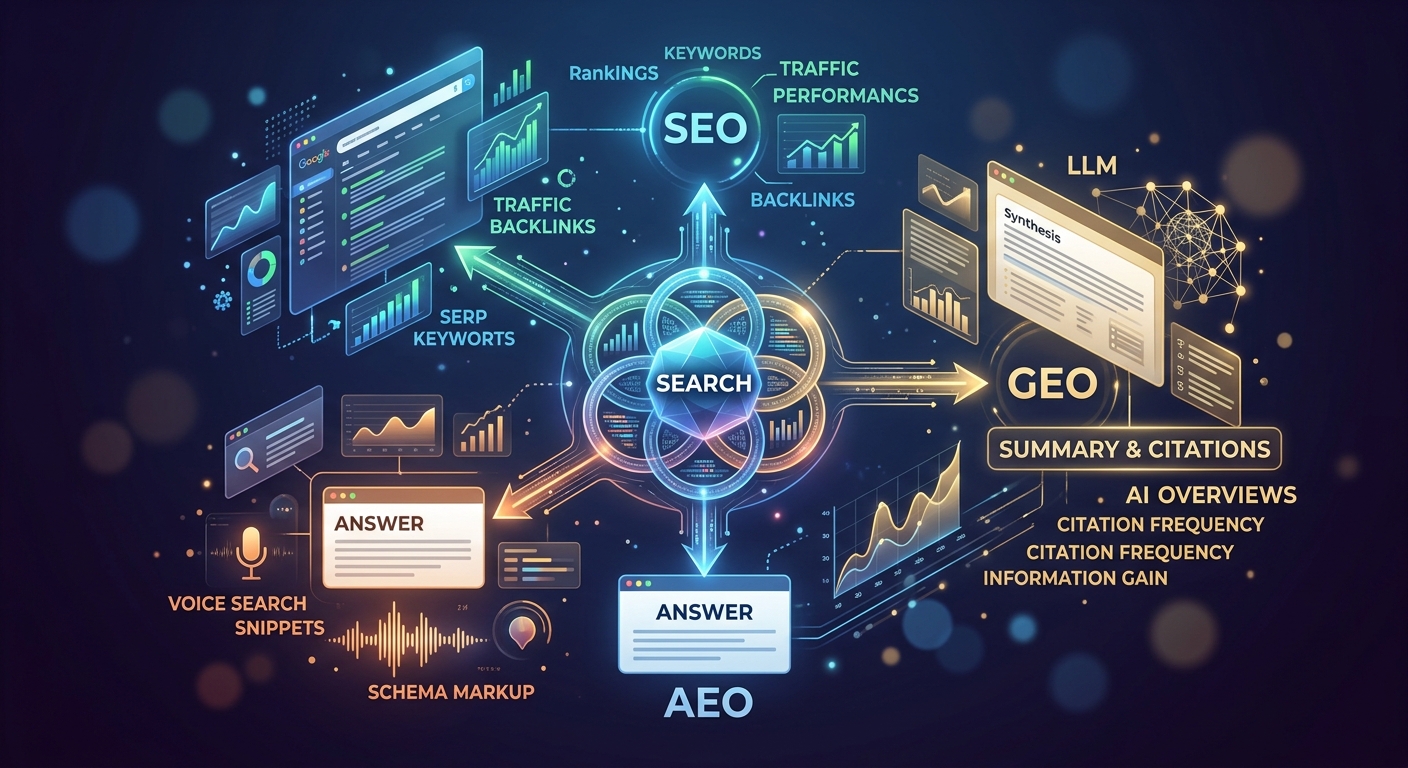
The world of digital search is undergoing its most dramatic transformation since Google first indexed the web. For decades, visibility meant one thing: ranking on the first page of a traditional search engine. Today, user habits have fragmented across classic search engines, voice assistants, and AI-driven conversational bots.
To stay competitive, modern marketers, business owners, and content creators must look beyond traditional Search Engine Optimization (SEO) and embrace two critical evolutions: Answer Engine Optimization (AEO) and Generative Engine Optimization (GEO).
1. What is SEO? (Search Engine Optimization)
Search Engine Optimization (SEO) is the practice of optimizing web pages, technical structures, and digital content to increase organic (unpaid) visibility and traffic from traditional search engines like Google, Bing, and Yahoo.
When a user types a query into a search bar, search engine crawlers scan millions of indexed web pages, evaluate their relevance and authority, and present a ranked list of results (often called the SERP or Search Engine Results Page).
The Three Pillars of Traditional SEO
To rank effectively in traditional search, you must optimize across three primary disciplines:
-
On-Page SEO: Focuses on the content visible on your website. This includes keyword research, crafting compelling title tags and meta descriptions, maintaining clear header hierarchy (
H1,H2,H3), and publishing high-quality, relevant content that matches user intent. -
Off-Page SEO: Focuses on building authority outside your own website. The primary metric here is acquiring high-quality backlinks from reputable domains, managing online reviews, brand mentions, and driving social engagement.
-
Technical SEO: Ensures search engine crawlers can efficiently discover, crawl, parse, and index your site without issues. Key elements include fast page load speed, mobile responsiveness, secure connections (HTTPS), clean XML sitemaps, structured URL architecture, and canonical tag implementation.
Why Traditional SEO Still Matters
Despite the rise of AI tools, traditional SEO remains the foundational bedrock of all digital discovery. Generative AI models and voice assistants rely on web indexers to crawl and understand website data. Without a sound technical SEO foundation, advanced search technologies cannot find or interpret your digital content.
2. What is AEO? (Answer Engine Optimization)
Answer Engine Optimization (AEO) is the targeted practice of structuring digital content so that search platforms and voice assistants can instantly extract direct, precise answers to user queries.
Rather than giving users a list of ten blue links to browse through, answer engines deliver single, definitive answers. AEO powers:
-
Featured Snippets: The prominent answer boxes that appear at the top of Google search results (often called “Position Zero”).
-
Voice Search: Responses provided by smart speakers and digital assistants like Apple’s Siri, Amazon’s Alexa, and Google Assistant.
-
Knowledge Panels & Q&A Cards: Automated informational boxes displayed alongside traditional SERPs.
Key Strategies for AEO Success
To capture answer engine real estate, your content strategy must shift from broad topic coverage to direct problem-solving:
-
Format Headings as Explicit Questions: Use headings that directly mimic natural phrasing, such as “How do I fix a leaking faucet?” or “What is the boiling point of milk?”
-
Provide a 40–60 Word Direct Answer: Immediately follow your question header with a concise, factual answer block before expanding into deeper details.
-
Implement Structured Data (Schema Markup): Use JSON-LD schema such as
FAQPage,HowTo,Article, andProductto help search engines read and categorize your exact content intent. -
Target Conversational & Long-Tail Queries: Voice searches tend to be longer and more conversational than typed queries. Optimize for full phrases rather than fragmented keywords.
3. What is GEO? (Generative Engine Optimization)
Generative Engine Optimization (GEO) is the newest evolution in digital discovery. It is the process of optimizing content to ensure it is selected, synthesized, and cited as a authoritative source by Generative AI models—such as Google’s AI Overviews, Perplexity AI, ChatGPT Search, and Claude.
Unlike traditional search engines that retrieve existing links, generative search engines read multiple sources across the web in real-time, synthesize the information into a single custom answer, and cite the primary sources that informed their response.
How GEO Differs from Traditional SEO
| Metric / Dimension | Traditional SEO | Generative Engine Optimization (GEO) |
| Primary Goal | Rank on Page 1 (Positions 1–3) | Get cited/linked inside AI-generated answers |
| User Experience | User clicks a link to visit a website | User reads synthesized text with linked citations |
| Content Focus | Keyword density & topic coverage | Information gain, original research, & authority |
| Optimization Key | Backlinks, metadata, keywords | Credible statistics, expert quotes, & clear entities |
How to Optimize Content for Generative AI (GEO Tactics)
-
Prioritize “Information Gain”: Generative engines prefer content that adds new, unique value. Simply repeating generic summaries available on twenty other blogs will lead to your site being ignored. Publish original research, proprietary survey data, case studies, and unique expert insights.
-
Double Down on E-E-A-T: Google and AI engines prioritize Experience, Expertise, Authoritativeness, and Trustworthiness. Highlight author credentials, cite authoritative primary scientific or industry sources, and keep factual details rigorously updated.
-
Use Concise Data & Named Entities: Large Language Models (LLMs) excel at processing structured data, clear bullet points, comparison tables, and well-defined terminology. Avoid vague jargon.
-
Strengthen Digital Footprint & Brand Mentions: AI models learn from broader entity recognition. Getting your brand mentioned across third-party industry journals, news sites, podcasts, and digital forums builds the contextual consensus AI models look for when recommending brands.
4. Comparing the Search Pillars: SEO vs. AEO vs. GEO
To visualize how these three methodologies work together, here is a side-by-side comparison matrix:
| Feature | SEO (Search Engine Optimization) | AEO (Answer Engine Optimization) | GEO (Generative Engine Optimization) |
| Target Platforms | Google, Bing, DuckDuckGo | Siri, Alexa, Google Voice, Featured Snippets | Google AI Overviews, Perplexity, ChatGPT Search |
| Primary Format | Long-form articles, landing pages | Q&A blocks, bulleted lists, Schema data | Comprehensive, source-rich, data-backed content |
| Measurement | Organic traffic, rankings, CTR | Snippet wins, voice answer share, impressions | Citation frequency, brand mentions, referral traffic |
| Core Trigger | Informational & transactional keywords | “Who, What, Where, How” question queries | Complex, multi-step, research-oriented prompts |
5. How to Build a Hybrid Search Strategy
Instead of treating SEO, AEO, and GEO as competing tactics, modern digital strategy requires a unified Hybrid Search Approach:
-
Establish Technical & On-Page SEO Foundations: Ensure your site is fast, mobile-ready, cleanly coded, and logically structured so crawlers can access your content without barriers.
-
Integrate AEO Elements into Every Post: Place Q&A headers, summary bullet lists, and appropriate Schema markup inside your long-form content to capture direct answer boxes and voice results.
-
Enrich Content for GEO: Add unique data points, direct expert quotes, verified source references, and original analysis that AI engines can extract as credible citations.
-
Track Brand Visibility Across Platforms: Monitor not only Google Analytics organic clicks, but also featured snippet wins and direct brand recommendations inside AI tools like Perplexity and ChatGPT.
6. Frequently Asked Questions (FAQ)
Is traditional SEO dead because of AI search?
No, traditional SEO is not dead. AI models and answer engines still rely on search indexers to discover and evaluate web content. Technical accessibility, crawlability, domain authority, and user experience remain essential prerequisites for appearing in AI-synthesized responses.
What is the main difference between AEO and GEO?
AEO focuses on extracting a single, direct, pre-existing answer for a factual query (e.g., featured snippets or voice answers). GEO focuses on influencing generative models that summarize multiple complex web sources to write custom responses and list credible citations.
How do AI engines decide which websites to cite in GEO?
AI search models evaluate websites based on content authority (E-E-A-T), semantic relevance, the presence of original data or statistics, clear author credentials, and how frequently the entity or brand is referenced across authoritative third-party sources.
Does schema markup help with GEO?
Yes. Schema markup provides clear, machine-readable context about entities, products, FAQs, and authors. This structured data makes it significantly easier for both traditional search crawlers and AI models to parse and verify the information on your page.
How can a beginner start optimizing for GEO today?
Start by updating your key content with unique value: include original surveys, expert opinions, direct quotes, clear statistics, comparison tables, and explicit source references. Ensure your authors have visible, credible author bios demonstrating real industry experience.
By unifying SEO, AEO, and GEO into a single cohesive publishing workflow, you position your brand to capture traffic from traditional searchers, voice assistant users, and the millions of users relying on generative AI for daily answers.


